

13 May 2026
Affordability in the private rented sector
The Renters' Rights Act which went live on 1 May 2026 marked a landmark moment for private renters in England. It introduced stronger security, an end to no-fault evictions, and fairer conditions for millions of households. But while security of tenure has improved, the everyday reality for many private renters is unchanged: the biggest pressure remains the cost of rent and the gap between what people pay and the help they receive, where eligible for support.
The UK Housing Review 2026 shows clearly that affordability for many in the private rented sector (PRS) is now being shaped by the way that help with housing costs is failing to keep up with rents. For many renters, this is the difference between affordable living and financial stress, as Vicky Spratt outlined in her article for the I paper ahead of the Budget last year.
More renters depend on help with their rent than ever before
As of May 2025, 6.58 million households were receiving universal credit (UC; a single monthly payment that helps people on low incomes or out of work with their living costs). Of these, more than four million were getting help with rent, including 1.67 million private renters. By April 2026, when the move from legacy benefits to UC was completed, that number settled at around 1.7 million private renters relying on support with housing costs. This is no longer a small safety net. It is a core part of how the PRS functions for low-income working and non-working households. (Social renters are not affected by LHA in the same way because their rents are usually covered in full by the housing element of UC.)
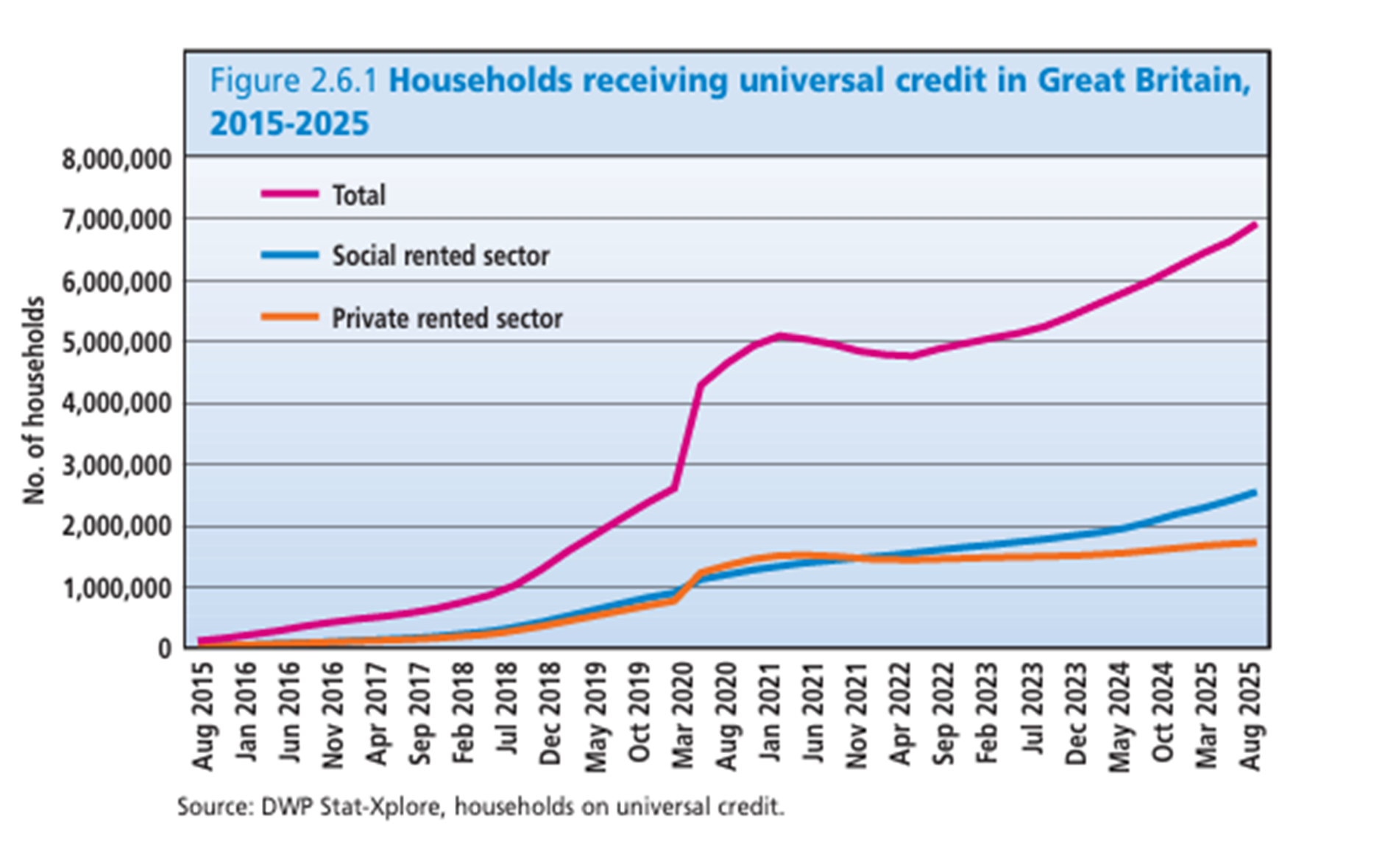
(You can explore the full data behind this in the UK Housing Review compendium of tables.)
Rents have risen while housing benefit has been frozen
The help private renters receive is capped by local housing allowance (LHA). LHA is meant to reflect the cheapest 30 per cent of rents in each area. In theory, this means someone on benefits should be able to access the lower end of the local market. In practice, repeated government decisions to freeze LHA rates have broken that link. The 2026 UK Housing Review shows that LHA was reset to the 30th percentile in April 2024. It was then frozen again in 2025 and remains frozen into 2026. In the meantime, rents have increased significantly.
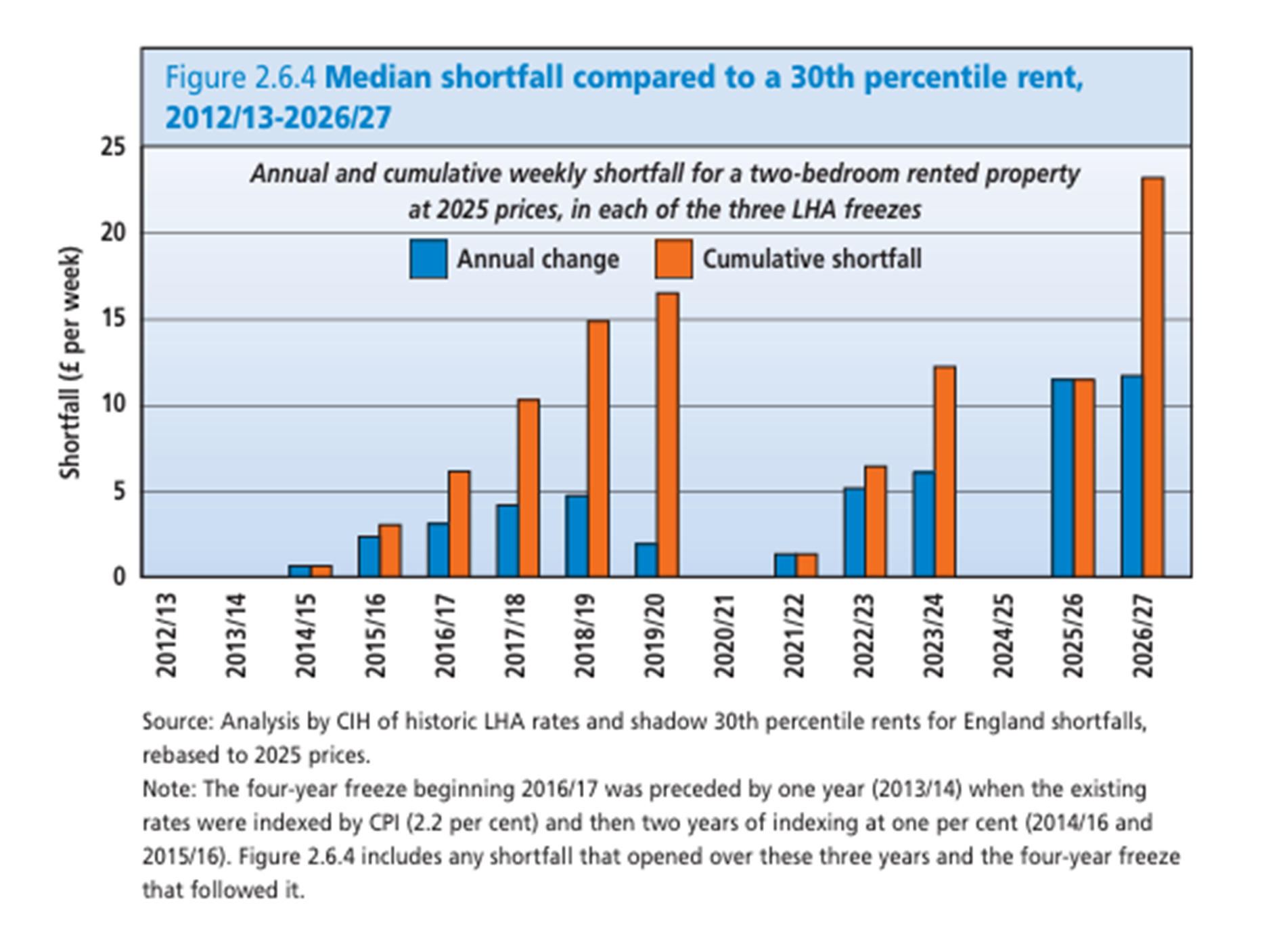
Data from the Office for National Statistics show private rents rose at historically high rates in 2023-25. During the first year of the current freeze, rent inflation averaged 8.6 per cent. This means the gap between what LHA covers and what tenants pay has widened faster than in any previous freeze period. By April 2026, the median shortfall for a two-bedroom home is around £23 per week - around £100 per month. That is money that has to come from somewhere – often food budgets, heating or debt.
Fewer homes are affordable
When LHA was reset in 2024, the proportion of claimants facing a rent shortfall fell from 67 per cent to 46 per cent. By early 2026, that figure had already climbed back to 54 per cent. The UK Housing Review shows that in England the frozen LHA rate now only covers around 20 per cent of the market across all property sizes. So a system designed to give access to the cheapest 30 per cent of homes now reaches only one in five.
The Renters' Rights Act gives renters more stability. But stability in a home that is unaffordable is not real security. If tenants cannot cover the shortfall between rent and LHA, they fall into arrears. They are then at risk of eviction under the new system just as they were under the old one.
The link to homelessness and temporary accommodation
The UK Housing Review makes it clear that artificially low LHA rates are pushing more households towards homelessness, as the BBC News has covered. When people cannot sustain their tenancy, councils pick up the cost through temporary accommodation. This is far more expensive for the public purse than maintaining LHA at a realistic level. This has been highlighted by various news outlets, including The Guardian, as local authorities report record spending on temporary housing.
What would fix this?
The UK Housing Review estimates that resetting LHA to the 30th percentile from April 2026 would cost around £300 million. That’s a lot of money but in the context of £26 billion spent on help with rent through UC, it is relatively modest. And it would reduce homelessness, reduce pressure on councils, and reduce hardship for low-income renters. In simple terms, it would reconnect support with the real world of house prices and rents.
The big picture for the private rented sector
With rising prices across the UK and a reduction in affordable lets, the private rented sector now houses many of the households who would once have been in social housing. It is also where a growing share of low-income working families and keyworkers live. That means affordability in the PRS is central to housing policy. The Renters’ Rights Act improves how people are treated as tenants. The UK Housing Review shows we now need equal focus on whether they can afford to stay.
If you want the full analysis, data and charts behind these findings, download the UK Housing Review 2026 for free today and explore the chapter on help with housing costs. It is essential reading for anyone working to make renting genuinely affordable.