

05 Nov 2026
Buying a home: Helping first-time buyers face a big challenge
Taking the step to buy your first home in the UK today can be a big hurdle to jump for many of today’s younger generations. This has given young people the sometimes-unwelcome title of ‘Generation Rent’. But, what does the state of housing really mean for first-time buyers?
The state of the UK housing market
The UK Housing Review Autumn Briefing Paper 2026 pointed out that ‘confidence is low, affordability is stretched, sales have been falling through, and turnover is down’.
When looking at the statistics on first-time buyers the annual UK Housing Review shows that although recent numbers are much higher than following the global financial crisis in the 2010s (Table 43a), new mortgage advances have not yet recovered to their recent high levels as seen in 2020 and 2021 (Table 41) – but still, just over half of new mortgages go to first time buyers.
Unaffordable for first-time buyers
Even when ignoring the need for a significant deposit, many renters have incomes that are simply too low to move into homeownership, given current house prices. Mortgage-market reforms may shift these margins in time, but the fundamental tension remains.
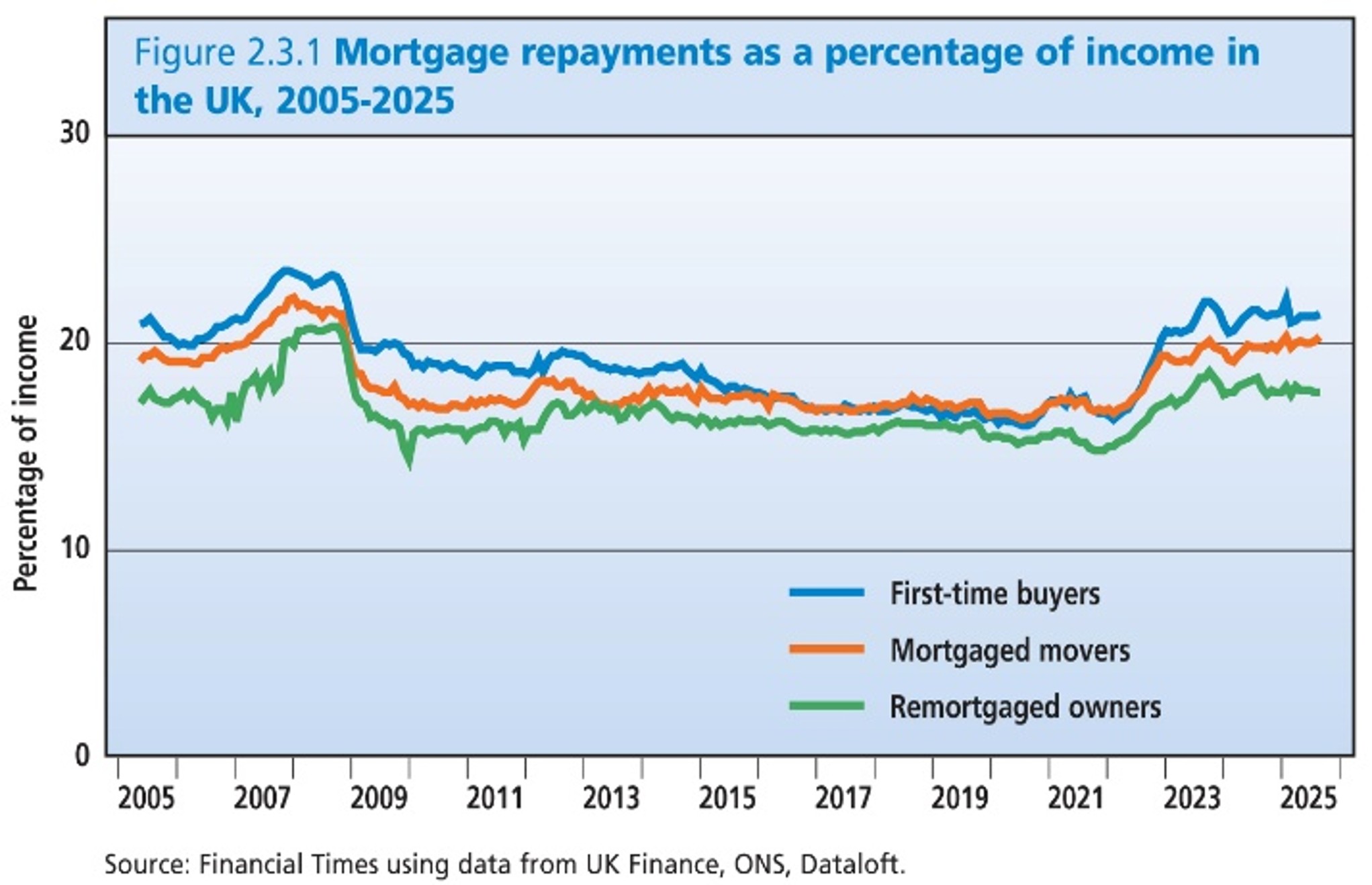
This is evident in the UK Housing Review Affordability Index (Table 45a), which uses average house prices and average gross household incomes data. It is also evident in analysis by Neal Hudson which shows that despite reductions in mortgage rates, rising incomes, and relatively stagnant house prices, affordability has not improved when examined on a more granular basis (see chart below). First-time buyer mortgage payments compared with incomes are currently less affordable now than they were for the whole period 2009-2022.
Changes to balance the sums for first-time buyers
Tax changes have favoured homeownership compared with renting, making more existing homes potentially available to first-time buyers, and there are huge numbers – the UK Housing Review notes an estimate of up to three million – of would-be buyers who are currently renting.
What can be done to ease the transition into ownership?
The UK Housing Review’s Autumn Briefing Paper highlights the ‘failing housing ladder’ at all stages of the life cycle and argues for more targeted help for new buyers.
Shared Ownership
Shared Ownership is of particular significance for lower-income buyers and a recent House of Commons report highlighted the tenure’s weaknesses and what is being done to tackle them. Not least of the issues has been inadequate data allowing policymakers and analysts to assess the programme. Though more needs to be done, the English Housing Survey has recently put a focus on the tenure. With the UK’s New Homes Quality Board now operating the Shared Ownership Code we can see some long-awaited momentum in this neglected tenure.
Your First Home (England)
The UK Autumn Budget saw the formal introduction of Your First Home, a £4.7 billion scheme to support 70,000 first-time buyers and build 20,000 new homes in England. It offers a 20% equity loan on new build homes, and is targeted via income caps and local property price caps. The first loans are expected to be issued in April 2027.
Your First Home is more limited and more closely targeted than England’s previous Help to Buy scheme. The UK Housing Review will be reviewing its potential and its impact as it is rolled out.
First-Time Buyer ISA
The Budget also included a new, UK-wide First-Time Buyer ISA, to replace the Lifetime ISA. It enables prospective buyers to save up to £4,000 a year and provides a 25% government bonus. There is a price cap of £450,000.
Other schemes around the UK
The other UK administrations continue with targeted schemes to help first-time buyers: Help to Buy - Wales, Shared Ownership and other schemes in Scotland, and Northern Ireland’s well-established Co-ownership scheme.
The UK Housing Review regularly examines the state of the housing market and the effectiveness of the incentives for first-time buyers, both via its full annual review in the spring of each year, and via each year’s Autumn Briefing Paper.
If you want the full analysis, data and charts behind these findings, download the UK Housing Review 2026 for free today. It is essential reading for anyone working in the housing sector.