

09 Mar 2026
Cautiously optimistic: reflections on the new national housing agency from Scotland's Housing Festival
CIH Scotland police and practice manager Ashley Campbell reflects on the key themes emerging from the “More Homes Scotland – a discussion” breakout session at Scotland’s Housing Festival.
On 22 January 2026, the first minister announced that the Scottish government intends to establish a new national housing agency called More Homes Scotland. The aim is to deliver new homes across tenures at scale and with speed by simplifying the system. We are still waiting for further details, but we know the initial plan is to focus on:
- Large scale, affordable housing projects
- Rural and island housing
- Acquiring, preparing and releasing land
- Enabling infrastructure to unlock stalled sites
- Closer working with the Scottish National Investment Bank to access private finance.
The Scottish government has committed to co-designing the new agency and is already in conversation with key stakeholders, so we decided to take advantage of Scotland’s Housing Festival on 3-4 March and run a breakout session on More Homes Scotland to ask our members what they thought of the proposals - and what success would look like.
Initial reactions from the audience
A live poll of our audience of around 70 housing practitioners suggests cautious optimism but a lot of uncertainty, likely due to the lack of detail available at this early stage of development. The majority of our audience (62 per cent) weren’t sure if the new agency would have a positive impact on supply. Twenty nine per cent answered positively and only nine per cent didn’t think the new agency would have a positive impact.
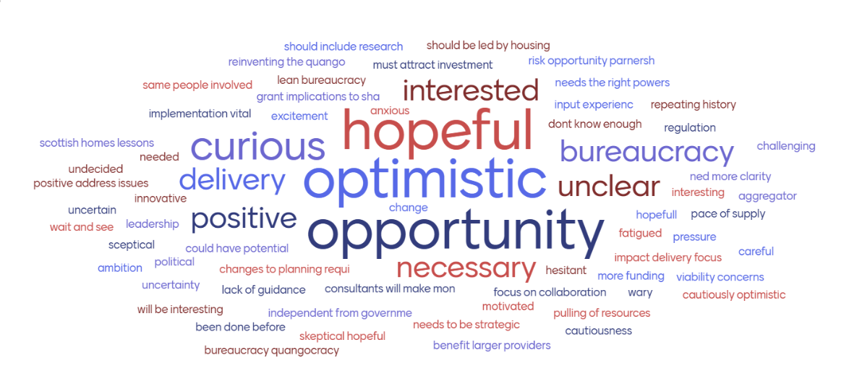
We also asked people to submit up to three words or phrases to describe how they felt about the proposed new agency to create a word cloud. The top answers presented a largely positive view with words like optimistic, opportunity and hopeful coming out on top. But below the surface, concerns and uncertainty were more evident and featured throughout the conversation.
It’s not perfect, but the current system has some positives
Housing providers have developed close relationships with local and central government which has taken time and there are concerns that these structures and knowledge could be lost. There was also concern about whether transitionary measures would be put in place and if development might suffer in the short-term because of uncertainty created by moving from the existing system to something unknown.
Ambitious timescales could hinder progress
The new agency is expected to be established by 2027/28 and to be fully functioning by 2028/29. While there was agreement that urgency is required to tackle homelessness and meet growing need, rushing the design and implementation runs the risk of producing an ineffective version of what we already have.
There was a definite preference for getting this done right, not just putting something in place quickly. A bold approach is needed to create something transformational and to avoid producing more of the same. The audience was clear that simply tinkering with the existing system would only lead to additional costs and bureaucracy without tackling any of the existing issues.
Skills, governance and accountability will be key
Housing organisations and practitioners, particularly those with development experience, must be at the heart of designing and running the new agency for it to be successful. There were some concerns about how the new agency would be structured and the potential for power struggles given the number of different prominent players that will have a vested interest, including local and central government, RSLs, investors and developers.
The new agency must have a clearly defined purpose so that progress can be monitored and leaders held to account
We know what the barriers to delivery are, and if they were easy to address it would have been done already. The new agency will need real powers and influence to make a tangible difference, particularly in relation to land assembly and infrastructure.
We need to learn from experience and build on what we have
The Scottish government must learn from previous experience of national delivery bodies in Scotland and further afield. We discussed the positive impact of the regional model adopted by Scottish Homes, and the lack of experienced housing professionals involved from the start being a missed opportunity, similar to the design of Integration Joint Boards (IJBs) which overlooked the essential role of housing. International examples to consider include England, Ireland and Canada.
There was also a call for the agency itself to undertake research to inform its work, to be guided by data and evidence.
Housing providers will need to adapt
There was some concern that focussing on large scale developments could lock out smaller providers. Though, in reality, many smaller social landlords have already moved away from development to focus on their existing homes and residents.
The business plans of those who are currently developing or have plans to in the near future may need to be reconsidered, but this wasn’t necessarily seen as inherently negative. New approaches could open the door for better partnership working, particularly between smaller associations.
There was wide agreement that local priorities should not be overlooked and that decision making should not be overcentralised.
Don’t forget the tenant voice
The tenant voice should be reflected in the development of the new agency and the way that new homes are delivered. A tenant representative in the room cautioned against delivering new homes at scale without considering the infrastructure needed to build communities.
How will we balance supply and affordability?
Of course, we couldn’t talk about delivering new homes without considering finance. How we fund the new homes we need is a complex issue, and while there was agreement that new finance models need to be explored, there were clear concerns about affordability and the impact on rents.
It must also be acknowledged that new development doesn’t happen in isolation and that housing providers still have to juggle and fund a range of challenges including maintenance and improvement of existing homes and the net-zero agenda. The new agency will have to work closely with a range of government departments to ensure these different priorities can be delivered in tandem.
It was also pointed out that access to finance does not guarantee the capacity to develop new homes and that the construction sector, planning departments and utility providers would all need to be geared up to deliver what’s needed.
For more information, contact CIH Scotland policy and practice manager Ashley Campbell: ashley.campbell@cih.org.