

10 Mar 2026
CIH International Group: New York study trip 2025

In all the trips I’ve been on or led for CIH, there is a generalised polarisation of views amongst my co-workers. Lille, Detroit and Mumbai got looks of disbelief – Why would you want to go there…? Rather you than me!...
On the other hand, Los Angeles a few years back, and most recently New York receives jealous looks. But in all cases, these trips are not holidays – we put in the slog walking around housing estates and building sites – represent our sector overseas – but because New York is still seen as so essentially glamorous, I think the majority of fellow travellers were self-funded, as was I.
It's ironic really. New York has always been a megacity of massive contradictions and for all its glamour, there is a homelessness epidemic, and levels exceeded those of the Great Depression for the first time last year. The funding for affordable housing is complicated and feels transitory, especially given the current federal administration, and (at time of writing) the upheaval for City Mayor.
The CIH International Group, accompanied on this trip by the Housing Foundation and Red Loft who helped organise the tours, saw four very distinct ways of affordable housing being developed for low waged individuals and families – typically preserving housing costs at no more than 30 per cent of salary. I’ve outlined these four case studies below.
Jonathan Rose Companies
Jonathan Rose aims to create a more environmentally thriving, socially just world through the development, preservation, renovation and ownership of green, affordable and mixed-income housing.

It leverages the combination of tax-exempt bonds, low-income housing tax credits, and a taxable loan to get to 62 per cent of costs of development, and has to seek local state, county and city subsidies for the rest. To say that housing financing in the US is complicated is putting it very mildly.

Nevertheless, Jonathan Rose has a portfolio of large substantial developments, with contemporary architecture and an impressive green specification. One such that we visited, Sendero Verde, a huge Passivhaus development – the biggest in North America.
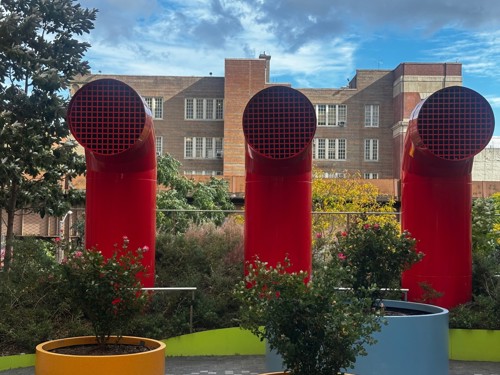
With 700 homes, and 100 formally homeless households, it also has an enviable array of community engagement facilities, a gym and IT room. Of course, given its height and location it also has one of the best views from the roof (including the top of Central Park) of any affordable housing we visited!
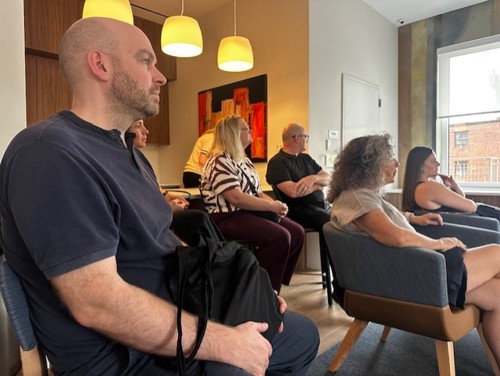
New York City Housing Authority
When we travel around the world, it’s funny how much common cause UK housing professionals have with colleagues in other countries, and at NYCHA (pronounced night-cha) conversations turned quite quickly to decants and hoarding, which raise the same problems across the Atlantic.

It was really kind of the team at NYCHA to take the time out of their day to spend with us. NYCHA is a goliath of a housing provider – it houses one in 17 of all the people in New York City, and if it were a city in its own right, it would be bigger than Atlanta. It enjoys a special public sector status as a result but has never had the funding it required to deliver the investment to its homes, some of which date back to the New Deal.
We visited one of these earliest estates (again uptown in Harlem) the beautiful River Heights Community. Despite NYCHA needing $78.3 billion to fully renovate and modernise its housing, with the federal government only providing a fraction of the required funding, River Heights has been fully refurbished – a great example of why NYCHA developed PACT (Permanent Affordability Commitment Together).
PACT unlocks funding through private and not-for-profit investors, who can leverage a tax credit, to deliver complete comprehensive repairs or build new modern buildings, while keeping homes permanently affordable and ensuring residents have the same basic rights as they possess in the public housing program.
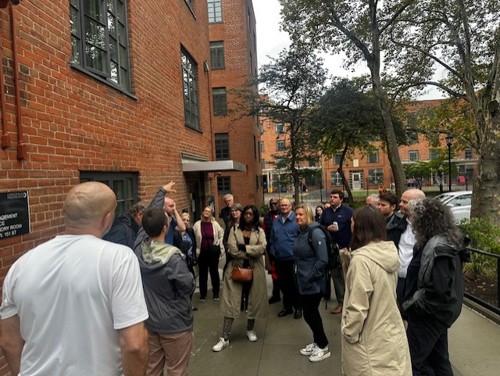
The homes remain the property of NYCHA, who also control what the UK would call ‘nominations’ but all building work, rent collection and repairs and management is delivered by new partners. At Harlem River Heights these were the Settlement Housing Fund Inc (non-profit), West Harlem Group Assistance (non-profit), and we met and were able to discuss the project with both Settlement and NYCHA.
Cirrus Real Estate Partners
Our trip continued with a ‘standing meeting’ outside the Barclays Center in Atlantic Avenue in Brooklyn. Cirrus joined forces with The Building and Constructions Trades Council (BCTC) and New York City in a public-private partnership to launch a $500 million fund to build new affordable workforce housing in NYC.
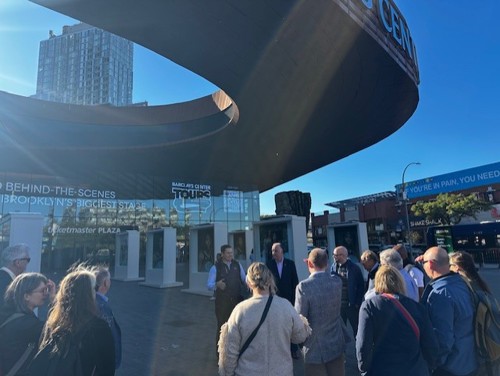
Cirrus, an NYC-based investment firm with a portfolio encompassing an estimated $150 billion of commercial real estate loans, has pledged to raise more than $400 million for the initiative. The Unions invested their pensions funds and were able to leverage that only union rates were paid for the works.

There were a substantial strip of high-rise apartments as well as the Barclay Center (a multi sports arena) in the scheme, and a new subway interchange system. The housing blocks stretch back to Vanderbilt Avenue, and the next phase involves building over a currently open to the air railroad depot.

What was notable was that the affordability of these homes were set to put them within reach of ‘workers’ although some of the costs would have made them more in reach than others. There was also the biggest modular homes construction in NY on the site, but this had aged badly and was apparently the passion of former Mayor de Blasio.
The Supported Housing Network of New York (SHINNY)

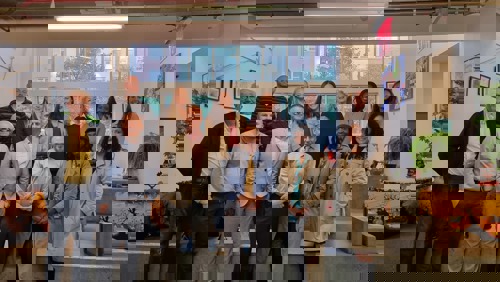
Our last visit was to meet the amazing team at Brooklyn Community Housing and Services (BCHS) at their base in the Navy Green building in Brooklyn.
BCHS are part of The Supportive Housing Network of New York (SHINNY) which is a non-profit membership organisation in New York City. The network represents over 200 non-profits that develop and operate supportive housing.
The network, established in 1988, continues to expand alongside the rapid growth of supportive housing. It now includes almost every supportive housing provider in New York. It also includes over 80 affiliate and corporate partners. Thanks in part to the network’s lobbying, there is a strong and currently growing provision across the state – but of course the need is growing more quickly.
Of all SHINNY’s member organisation’s clients, half are over 55 and just over half identify as black – and all of them are facing the hardest barriers to finding housing and then maintaining it. We found the BCHS Nay Green building to be full of light and colour. The residents enjoy gardening, and the building was co-designed with them to recreate the ‘front porch’ effect of American neighbourhoods.
BCHS have their own refurbishment and development plans – funded in similar ways to the other developers we met – highly intricate combinations of tax credits and investor funds and bonds.
Learning
Having not been to New York since the early noughties, I was a little shocked to see that there appeared to be less obvious street homelessness and begging than I experience day to day in London.
This is unlikely to be due to the interventions that we saw but was certainly worthy of consideration.
I think that also, what was apparent was the determination and drive amongst the workers and leaders in the organisations that we visited. It was demonstrated very clearly by Jonathan Rose Companies just how difficult it was to secure 100 per cent funding for affordable housing – for investors, the question would be ‘why would you bother’.
What we experienced was the hyper philanthropy of the investors linked with top-up subsidies, and support, land etc from the state and city authorities.
Also, the movement away from limited person-based tax credits to an unlimited property-based tax credit really makes the difference – we also saw this on our trip to San Diego.
It’s a fragile web however, and the feeling of threat from federal government was ever-present, with the feeling that the axe hadn’t yet fallen – but that it would only be a matter of time.
Miles is chief executive at Chisel Housing