

26 Mar 2026
Putting health at the centre of housing and urban design

With this year’s UK Housing Review examining how good home and environmental design can support both mental and physical health, Andrew Charlesworth-May explores how MHCLG’s updated Appraisal Guide helps stakeholders measure the real health value of investing in better housing and places.
It is vital that health outcomes are considered from the start of any new housing and urban environment project. However, there is currently a lack of accessible evidence and tools available to fully understand the health impacts of design decisions.
To fill this gap, MHCLG analysts worked with the TRUUD (Tackling the Root Causes Upstream of Unhealthy Urban Development Decision-making) university consortium to develop an approach to assessing the health impacts of urban and building design in planning and funding decisions.
The approach has been incorporated into MHCLG’s (Ministry for Housing, Communities and Local Government) Appraisal Guidance, which shows how analysts, agencies and local authorities can effectively assess the impacts of housing and urban design interventions.
The impact of housing and urban design on health
The consortium has conducted a comprehensive review of the academic health literature. It identified nearly 200 features — or pathways — which impact on health, including building design, climate change, community infrastructure, the natural environment, the socio-economic characteristics of the area and transport features.
They include critical factors affecting health highlighted in this year’s UK Housing Review, such as space needs, overcrowding, protection from cold and overheating, access to services, and hazardous conditions such as damp and mould.
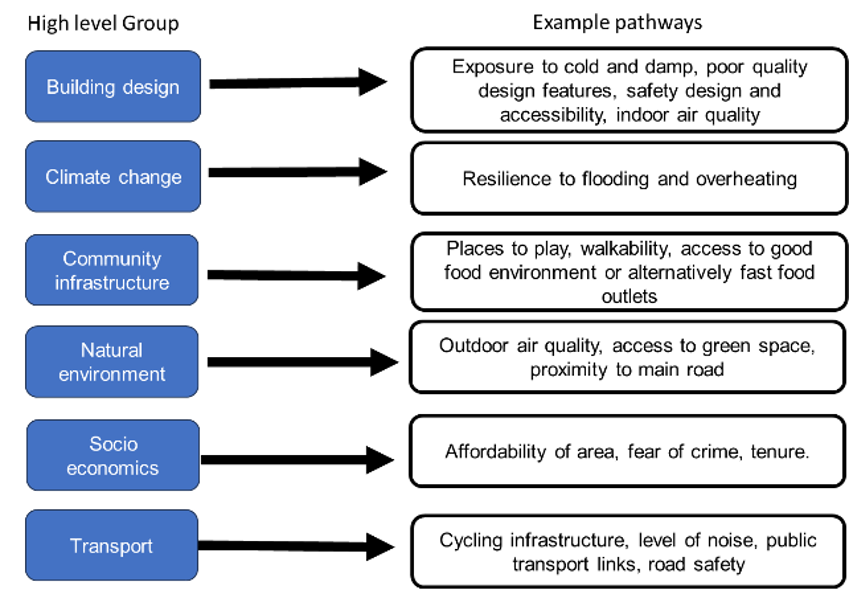
Example characteristics considered by the consortium's and used in the resulting HAUS model
TRUUD has also assembled evidence on the total cost of ill health to society. This is broken down into three separate types of cost:
- Direct costs (health and social care)
- Indirect costs (productivity and informal care)
- Disutility costs (pain and suffering associated with disease and premature mortality).
The economic case for healthy homes and communities
Building on this evidence, and to examine the impacts from various interventions that change the design of urban areas, TRUUD developed its Health Appraisal of Urban Systems (HAUS) model. The approach considers conditions indoors, as well as those outside and around our homes.
HAUS therefore guides decisionmakers on the types of interventions that will lead to better health outcomes. It also shows how delivering well-designed homes and places to live can reduce the costs of ill health and support a healthier, happier and more productive society.
How does the approach work? To begin with, the design features of the existing environment and the population they impact on are understood, following which alternative design feature scenarios are created and the population health impacts — both morbidity and mortality — are examined. The change in health impacts can then be calculated and valued.
The HAUS model allows impacts to be modelled over time, reflecting the fact that design will impact more than one period. The model also produces outputs that can be used in MHCLG and local partner impact and cost-benefit analysis, enabling stakeholders to consider health for the first time.
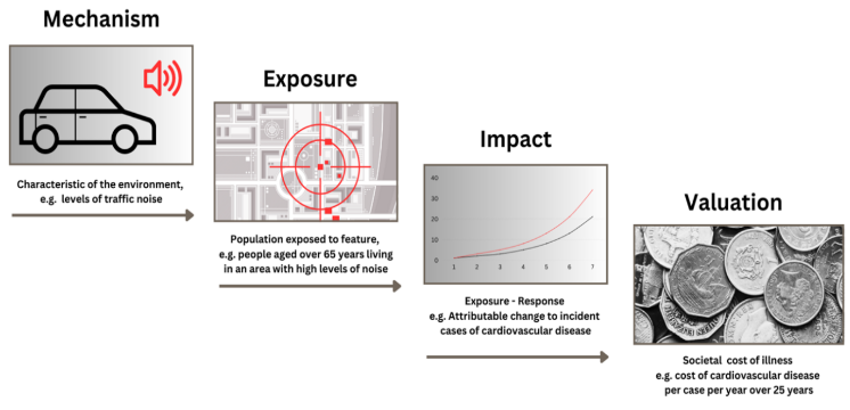 The HAUS model estimates the health impacts of different urban features
Stakeholder engagement
Engagement with stakeholders has ensured the model meets their needs, both across sectors and decision-making spaces. The Department of Health and Social Care (DHSC), in particular, has proved a key partner, as its work helps to reduce demand on the NHS through early intervention in the environment.
Local authorities and planners have also been actively engaged and have welcomed the model. Meanwhile, the World Health Organisation has used the work MHCLG analysts did with TRUUD to produce a case study for its publication.
We hope to ensure take-up of the model is maximised through this active stakeholder engagement, in partnership with DHSC.
Going forward, the model’s evidence base will grow stronger, and the model itself developed further so that so it can be used as easily as possible. The MHCLG Appraisal Guide will be updated to incorporate these changes.
- The 2026 edition of the UK Housing Review is now live —explore all chapters and more HERE
Main image: A residential development in London (cr: Shutterstock)
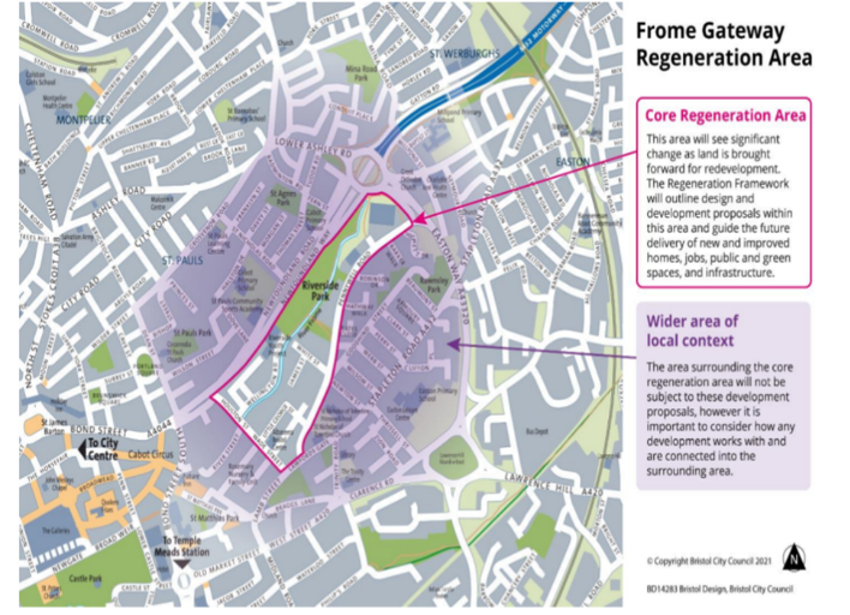
Frome Gateway is a 14.7-hectare piece of land surrounding the River Frome in Bristol, with a mixture of industrial and residential land. The site sits within Laurence Hill Ward, one of the most deprived in the country with high levels of unemployment and poverty.
The HAUS model was applied to understand the health implications of several options for redeveloping the area. The lead option had over £80 million in health benefits compared with the baseline no intervention option.
Benefits came mainly from improved wellbeing and reduced obesity due to access to:
- More and better-quality green space
- Opportunities to more walking and cycling
- Reduced noise pollution.
Andrew is the economic appraisal lead at MHCLG. Sarah is a professor of public policy and governance at the School for Policy Studies, University of Bristol. Geoff is a lecturer in public health policy at the Institute for Policy Research, University of Bath. Eleanor Eaton is a research fellow at the Department of Economics, University of Bath.