
30 Jul 2026
Scotland’s housing emergency: How did it happen and where are we now?
Why was a housing emergency declared?
Academics, practitioners and policy makers agree that the current housing situation in Scotland didn’t happen overnight, but we are now feeling the cumulative effects of decades of under supply, the COVID-19 pandemic, demographic changes and global economic challenges.
Stagnation in new housing supply, low turnover of social housing lets and affordability issues in the private sector have led to the highest rates of homelessness since records began, increasing lengths of stay in temporary accommodation and some local authorities regularly breaching their statutory duties towards homeless households because they simply do not have the capacity to deal with the volume of housing need. The Scottish Housing Regulator has identified the situation as systemic failure, not the failure of individual local authorities.
Argyle and Bute was the first local authority in Scotland to declare a housing emergency in June 2023. This announcement was followed by other local authorities across Scotland with the Scottish government eventually declaring a national housing emergency in May 2024.
In this year's UK Housing Review you can find out more about the status of housebuilding, lets and homelessness figures in Scotland as well as compare them across the wider UK.
What is a housing emergency?
There is no official definition for a housing emergency in Scotland and the declaration in itself did not trigger any statutory response or automatic additional funding. It did signal that the Scottish government acknowledged that the issues with housing were serious enough to warrant a national response.
In future, because of the Housing (Scotland) Act 2025 ministers will have powers to introduce regulations in the future setting out the definition of a national housing emergency and any actions that should be taken if one is declared. They will also have powers to set regulations in relation to local housing emergencies and what local authorities would have to take into account.
What is happening in 2026 to solve the emergency?
In the year following the declaration of the national housing emergency, the Scottish government carried out a number of actions intended to ease pressure on the housing sector including:
- Increasing the Affordable Housing Supply Programme budget in 2025/26 to £768 million (although this followed a previous cut to the budget of almost £200 million)
- Providing additional funding for the local authorities with the greatest pressure on homelessness services
- Asking social landlords to work on reducing void times between tenancies
- Working on “stalled sites” where planning permission has been granted but building has not started
- Considering options through the Housing Finance Taskforce to attract private investment and boost housing supply.
The Scottish government published a more detailed Housing Emergency Action Plan in September 2025 with three key objectives:
- Ending children living in unsuitable accommodation
- Supporting the housing needs of vulnerable communities
- Maximising investment in Scotland’s housing sector.
Has housing supply improved since the housing emergency was declared?
New homes cannot be delivered overnight. Policy changes and funding increases inevitably take time to filter through to construction and the number of new homes being delivered is falling far short of identified need.
Research published by CIH Scotland, Shelter Scotland and SFHA in 2025 found that 15,697 social and affordable homes need to be delivered each year for the next five years to tackle the backlog of homeless cases and meet emerging need.
The Scottish Government’s latest new build statistics up to the end of March 2026 show:
- The total number of new homes completed across all tenures in 2025/26 was down 10% on the previous year. Starts were down by 4%
- Private sector completions were down 8% and starts down 12%
- Social sector completions were down 16% but starts increased by 25%.
The increase in social housing starts is encouraging and will feed through into increased completions in later years. However, overall delivery is still falling short of demand leading to affordability issues and pressure on homelessness services.
How is affordable housing funded in Scotland?
The Affordable Housing Supply Programme is managed by the Scottish Government and provides grant funding for social housing, intermediate tenures such as mid market rent and for low cost home ownership.
Grant levels vary between developments and include factors such as location, energy efficiency levels and whether the home is for social or mid-market rent. Housing associations also tend to be awarded higher grant levels than local authorities. You can see the current benchmark levels here, although this is a guide and social landlords may be able to negotiate for higher rates based on financial viability of individual developments.
The latest AHSP report for 2023/24 shows that the average grant rate for a social rented home delivered by a housing association was 62% compared to 44% for local authorities. The remaining costs will be covered by borrowing and repaired through rental income.
Has homelessness been improving?
The Scottish government has a longstanding commitment to tackle homelessness and published its Ending Homelessness Together Action Plan in 2018 and updating the plan in 2020.
Rapid Rehousing Transition Plans (RRTPs) were introduced by local authorities in 2018 setting out how they would reduce the use of temporary accommodation and scale up the use of Housing First for those who need it. Housing First is now operating in 26 out of 32 local authorities and the Scottish Government publishes regular monitoring reports.
The Housing (Scotland) Act 2025 will also introduce a new duty for certain bodies to take action to prevent homelessness. The “ask and acct” measures are currently under development and more information can be found in the Knowledge Hub.
Despite the Scottish government’s focus on reducing homelessness, increasing demand and financial pressures have resulted in a rise in homeless applications and longer periods of time being spent in temporary accommodation.
What is happening in the private rented sector?
Affordability has been a key issue in recent years with rents rising significantly in hot spots like Glasgow and Edinburgh increasing the risk of homelessness.
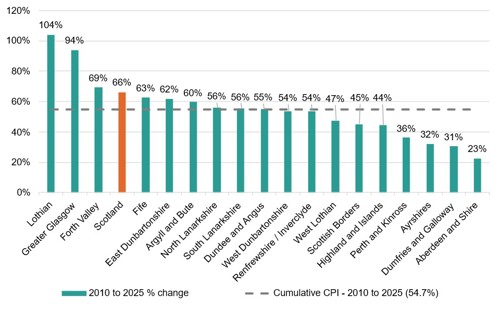
Source: Scottish Government Private Rented Sector Rent Statistics Scotland 2010 - 2025
The Scottish Government has introduced new rent control measures through the Housing (Scotland) Act 2025. The legislation will require local authorities to analyse and report on the PRS in their area every five years and make a recommendation as to whether a rent control area (RCA) should be introduced to address excessive rent increases.
The first local authority reports are due in May 2027. If an RCA is introduced, rent increases will be limited to CPI + 1% up to a maximum of 6%.
The Scottish government has already introduced regulations to exempt mid market rent homes and build to rent developments from rent control measures. They are also expected to consider exemptions for individual landlords. For example, increases above the rent cap level could be allowed to cover the costs of improvements such as meeting minimum energy efficiency standards. You can find out more about rent control on the Scottish government website.
If you want the full analysis, data and charts behind some of this data, download the UK Housing Review 2026 for free today and explore the chapter on help with housing costs. It is essential reading for anyone working to make renting genuinely affordable.