
03 Jun 2026
The quiet decline of right to buy
The right to buy (RTB) scheme – created 56 years ago as a means of rapidly boosting homeownership – has been in steady decline for the last decade. While remnants of it will continue in England and Northern Ireland, a combination of market factors and government policy look certain to reduce sales to a trickle from 2027 onwards.
What is right to buy (RTB)?
First introduced in the Housing Act 1980 and the Tenants’ Rights, etc. (Scotland) Act 1980, the UK Housing Review has documented RTB since its first issue 34 years ago. The scheme allows long standing tenants to purchase their home at a discounted rate.
Most recently, Alan Murie, the acknowledged expert on the history of RTB, made a comprehensive assessment of its effects on housing policy in the UK Housing Review 2022. It was updated in a short article in the UK Housing Review’s 2024 Autumn Briefing Paper.
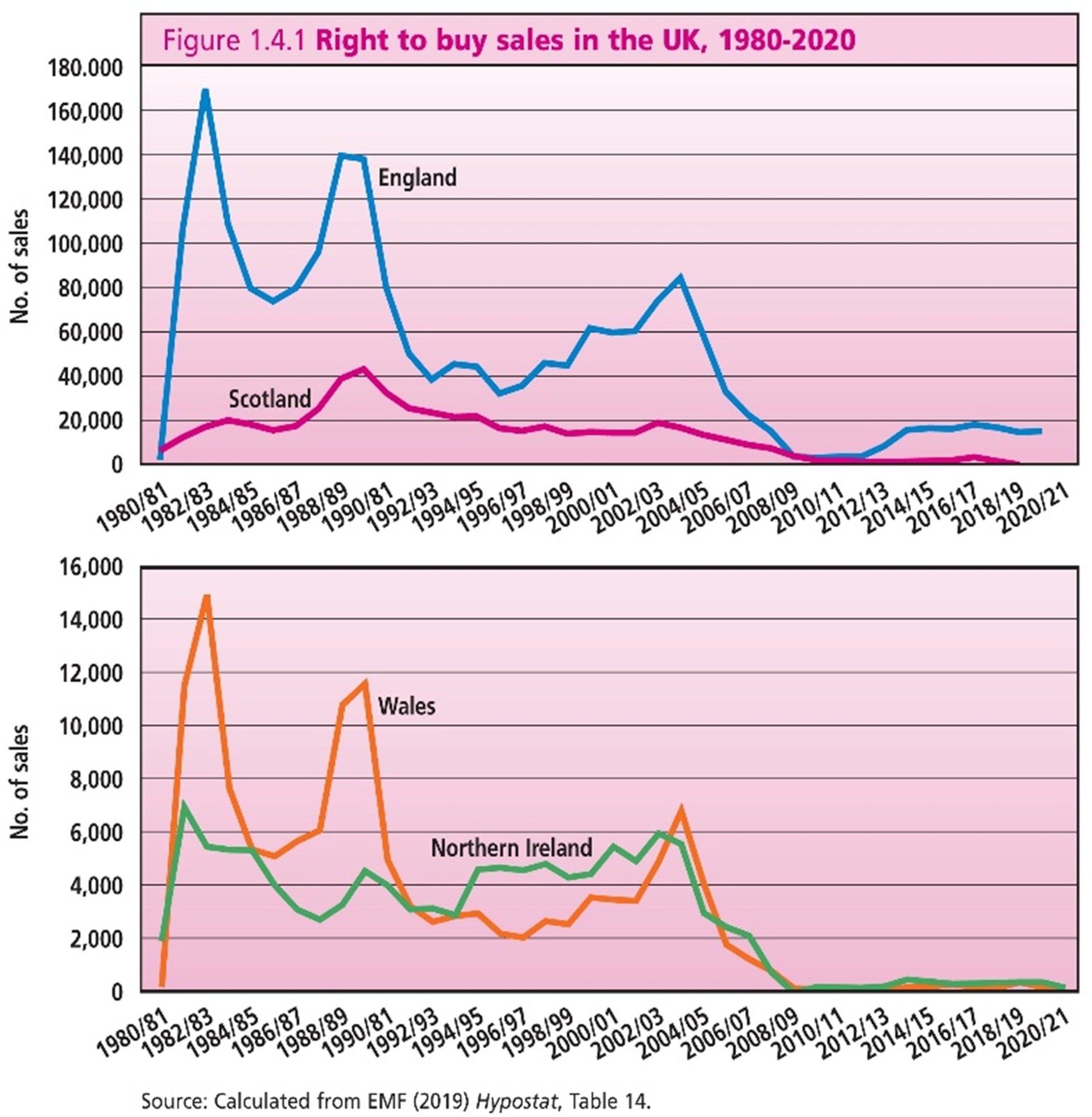
Since RTB started, around 2.7 million homes have been sold across Great Britain and a further 120,000 under the similar scheme in Northern Ireland. The latest statistics can be found in each edition of the UK Housing Review, in compendium table 21. These show that the last time there were more than 20,000 sales of homes in a year was in 2016/17; since then, sales have fallen almost progressively to just 9,236 in 2024/25.
Why is right to buy declining?
This decline has happened despite the Conservative government’s measures to ‘reinvigorate’ RTB in 2012. Discounts in England were raised dramatically and tenants could exercise the RTB after just three years. This boosted sales temporarily, but the decisions by the Scottish government to end RTB in 2016 and by the Welsh government to do the same in 2019 sounded the death knells. A voluntary RTB scheme for housing association tenants in parts of the West Midlands began in 2018 but it was soon discontinued as being too costly and cumbersome.
Two charts from the UK Housing Review’s 2022 edition (if slightly out of date) give an at-a-glance picture of decline, including the falling numbers under Northern Ireland’s similar scheme.
Right to buy’s long-term consequences
What have been the long-term effects of RTB? Alan Murie’s 2022 article called RTB a ‘strategic failure’ in England (in particular) and called for a radical review. This did not take place until Labour returned to power at Westminster in 2024 (see below).
Over more than five decades, RTB has reshaped the housing market, especially In England. It was the biggest single boost to homeownership, which peaked in the early 2000s (at 69 per cent of households). In crude terms, of the 18 million UK homeowners in 2005 (see the UK Housing Review’s compendium table 17), around 2.3 million (or some 14 per cent) had become owner-occupiers by buying their council home.
The problem, of course, was that the sales took place at the expense of the loss of future lettings to social tenants. As Murie also points out, the effects were made worse for two reasons. One was that the rapid growth in RTB sales came at a time of cuts in government spending on social housing. The other was that, rather than allowing councils to plough their receipts from sales back into their stock, for most of RTB’s history they had to pay significant shares back to the Treasury. RTB was, in effect, the UK’s biggest-ever privatisation, with proceeds from sales now reaching almost £62 billion across England, Scotland and Wales (UK Housing Review, compendium table 61).
After 2012/13, when discounts were raised substantially, the government belatedly started to log the numbers of homes ‘replaced’ in England via reinvestment of receipts. Thirteen years later, by March 2025, some 51,000 replacement homes had been built, fewer than half the 132,000 homes sold over the same period.
Recent changes in England
When the Labour government took office in 2024 it made substantial changes to RTB in England. From November 2024, discounts were cut to similar levels to those applying before the 2012 increases. The government also confirmed councils’ ability to reuse 100 per cent of receipts and introduced other flexibilities aimed at encouraging the reinvestment of receipts in new homes.
The government also issued a consultation on much broader reforms to RTB, to which CIH responded in January 2025. The outcome of the consultation was published in July 2025 and the further reforms confirmed in April 2026. Several of them are dependent on forthcoming legislation.
The changes include several recommended by CIH, such as a longer qualifying period (10 years) and greater protection from sales for recently built homes. In effect, the overdue reappraisal of RTB, called for by Alan Murie, as at last taken place in England.
The cumulative effect is likely to be a sharp fall in RTB sales once the reforms take effect. In the meantime, there has been a short-term rise in sales due to a short gap between the announcement of reduced discounts in 2024, and the date when the changes took effect. Three-quarters of the way through 2025/26, local authorities had recorded around 11,000 sales – a significant increase on the previous year, but much lower than many commentators expected when the changes were announced.
If you want the full analysis, data and charts behind these findings, download the UK Housing Review 2026 for free today and explore the chapter on help with housing costs. It is essential reading for anyone working to make renting genuinely affordable.