

16 Jul 2026
What it takes to become a Rising Stars Cymru winner

CIH Cymru's latest Rising Stars Cymru award winner, Katie, tells us about her experiences in the housing sector and what led to her winning her award.
How did you get into housing and your current role?
Honestly like most people who work in housing, I think I somewhat fell into the sector. I’d always wanted to do something that allowed me to help people but I’m useless with blood so that ruled out anything connected to medicine or dentistry, and teaching never called to me the way it does for those who become incredible teachers. With traditional career paths to helping people removed, I found myself working in social value, championing community benefits, stakeholder collaboration, and the delivery of added social value, but the impact still felt somewhat limited for me. I loved that role, and my background in social value was instrumental in me enjoying and making the most of my first role in Tai Tarian. Housing had previously never been presented to me as a career option, I wish it had been, and yet it has provided me with the opportunity to deliver on that early childhood hope of helping people and making a real impact.
I initially started with Tai Tarian as a maternity cover in our customer and community team, ensuring that the community benefits obligations of all our contractors supported not only the local community, but our tenants as well. A large part of that role included working with our development team and the contractors building and regenerating our homes, ensuring they met the Welsh Government targets for community benefits and recording the impact of our work, so it was somewhat familiar territory for me.
Within a few weeks of starting in that role, my current position was advertised. I was apprehensive at first, it felt like a huge step into the unknown but after some encouraging words from my brother-in-law, who also works at Tai Tarian (thank you, and I owe you one), it was an easy decision and it’s the best career decision I’ve ever made.
It’s a privilege to be able to say your work has a tangible impact on someone’s life and that’s what working in housing means.
Tell us a bit about your role and why you love it
As Tenant Engagement Officer for Tai Tarian it’s my job to ensure that at every level of the organisation, the opinions and experiences of our tenants are not only considered but are acted upon. Tenants are at the heart of everything we do. Without them Tai Tarian wouldn’t exist and it’s absolutely critical that their individual voices and those of the collective are represented and heard.
The creation of my role in 2024 was in direct response to Tai Tarian wanting to strengthen that voice. It’s the reason we redesigned our approach to tenant engagement; moving away from a singular tenant panel to our new framework based on three levels of engagement which was created in partnership with our tenants. We recognised that not all tenants can or want to give their time to work with us, and that’s fine, but we wanted to give them an opportunity to get involved in ways that work for them. The new approach is centred on three pillars: INFORM, INVOLVE and INFLUENCE. This allows tenants to choose their level of involvement, whilst giving the flexibility to the business to use a common-sense approach to engagement.
Tenant insights, experiences and interests shaped the framework and how they can get involved with us. We now have six tenant voice groups based on their feedback: communications and digital, communities and homes, environment and sustainability, repairs, scrutiny, and value for money.
Now that the new tenant engagement framework is live, my job is to make sure it’s used by the business; whether through consulting our tenants on what our approach to complaints should be or asking their opinion on our solar panel installation and how to tackle tenant refusal rates. The framework is there not only to provide tenants with a platform to work with us, but to provide the business with assurance that what we’re doing is in line with 1) the tenants’ expectations and needs, 2) our values “Be Bold, Be Kind, Be Fair” and 3) that we deliver on our Corporate Plan.
I always say to colleagues, tenant engagement doesn’t need to be scary or intimidating, which it might seem to be if you’ve never worked in engagement. Rather, it all starts with a simple conversation. Tenants want to feel respected and involved in what we do, and it’s my job to make sure that happens!
There’s no denying that there’s a power imbalance in the landlord/tenant relationship but effective tenant engagement, where tenants feel valued and respected, is invaluable and can help that imbalance feel less daunting.
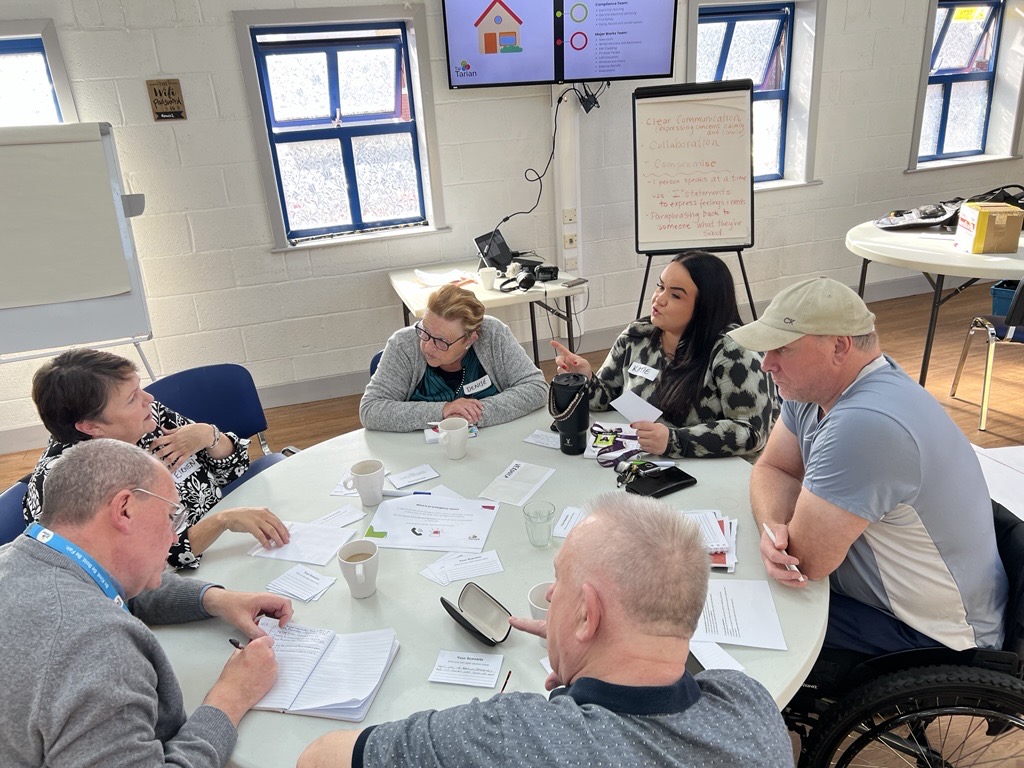
We’re as embedded into the community as our tenants are. Landlords own the houses yes, but it’s our tenants, their families and the wider community that make them homes, and for me that’s what makes my job enjoyable. Seeing the pride on the faces of our tenants when the work they’ve done with us is rolled out is one of the best bits of my job. I find it really encouraging when I hear from new tenants who have heard from their neighbour, their friend or a family member about how much they’ve enjoyed working with Tai Tarian and want to give it a go for themselves. I know it’s not for everyone, and sometimes after giving it a try tenants decide to drop out, but that’s equally important to me because they’ve tried and I couldn’t ask for more.
I think my favourite part of my job by far though is seeing the change in tenants as a result of their engagement with us. I’ve seen tenants go from feeling isolated and unsure of the power in their voice to actively participating with us, speaking confidently in a room full of people, finding friendships with other tenants and fully understanding that their opinions and experiences are valid and matter. You can’t put a price on seeing that change in someone.
What are your career ambitions?
My main ambition is to continue making a difference to tenants – I know that’s possibly a cheesy thing to say but I’d argue that if you don’t want to make a difference to the lives of tenants then you’re working in the wrong sector.
I could sit here and say that I absolutely want to be Director of Housing or even Chief Executive one day, but I’ve only been in the sector two years so that would be disingenuous of me. There’s so much more for me to learn and understand about housing before I can think about roles like that. I know it’s possible to work my way to those positions, should I want them one day, I only need to look at the examples set by the executive and senior management teams in Tai Tarian to see that. What I do know is that I’d like to progress into a management role of some kind and help to drive the change I want to see for tenants. I’ve built a fantastic relationship based on trust with our tenants and it’s incredibly important to me that we improve as an organisation based on their feedback, and I think moving into a more senior role would allow me to shape what that change looks and feels like both for the tenants and Tai Tarian as an organisation.
I can say with complete certainty though that I absolutely want to stay in housing, I can’t really imagine working in a different sector now.
Housing as a whole is such an incredible sector, it’s supportive, it’s welcoming and it’s bigger than I ever realised with no shortage of career opportunities. I’m incredibly fortunate within Tai Tarian that I can see how colleagues have progressed during their time with the organisation and the opportunities they’ve been able to take in their careers. There’s no shortage of role models and people to ask for support here, and I really couldn’t ask for more.
I’m also really looking forward to shadowing Michelle Reid, Merthyr Valley Homes Chief Executive as part of my prize for winning the Rising Star award. Given that Michelle was previously Chief Executive of TPAS England, and Merthyr Valley Homes are a community mutual housing association much like Tai Tarian, it felt like a great fit to shadow her. I’m incredibly grateful for the opportunity and can’t wait to see what I learn from her.
What achievements are you most proud of?
I’d say winning the Chartered Institute of Housing Cymru Rising Star Award is probably my proudest achievement. When I found out I’d been shortlisted it meant that much more to me because it was my colleagues who’d submitted the nomination on my behalf, so it was quite a shock when the email landed in my inbox! I had colleagues telling me how much of an honour it is to even get shortlisted, so to go on and win the award was truly incredible.
I’m also incredibly proud of the difference that our new tenant engagement framework is having on the lives of our tenants. The framework only launched a few months ago and I can already see the difference it’s making to both tenants and the business. One of the best outcomes I could have asked for following the launch is the uptake across the whole organisation; there isn’t one area of the business that hasn’t engaged with the new framework which is already driving better outcomes for all tenants.
In 2025, Tai Tarian took part in a research project with Swansea University to better understand tenant sentiment towards the new Welsh Housing Quality Standards 2023. The research took place across four community-based workshops with our tenants and it’s a fantastic piece of work. Tenants have since described the workshops as training, saying that off the back of it they now feel like they understand and have a deeper appreciation for the work we must do as their landlord to improve their homes. They’ve spoken about how previously, while they understood that legislation shapes what we do and how we do it, they now have a newfound appreciation for the work that goes on behind the scenes to deliver this and just how complex it can be. One of the tenants who took part in the project is now championing the difference that works completed as part of WHQS have had on her home. She’s taking part in a feature article in our tenant newspaper, ‘Cartref’, and is sharing the difference solar panels have made on her energy bills. In addition to this though, she’s helping us tackle misinformation around solar panels and encouraging her friends, family, neighbours and the wider community to have them as well. She’s a fantastic advocate for tenant voice, and her willingness to share her experiences with us, both positive and negative is exactly what we need.
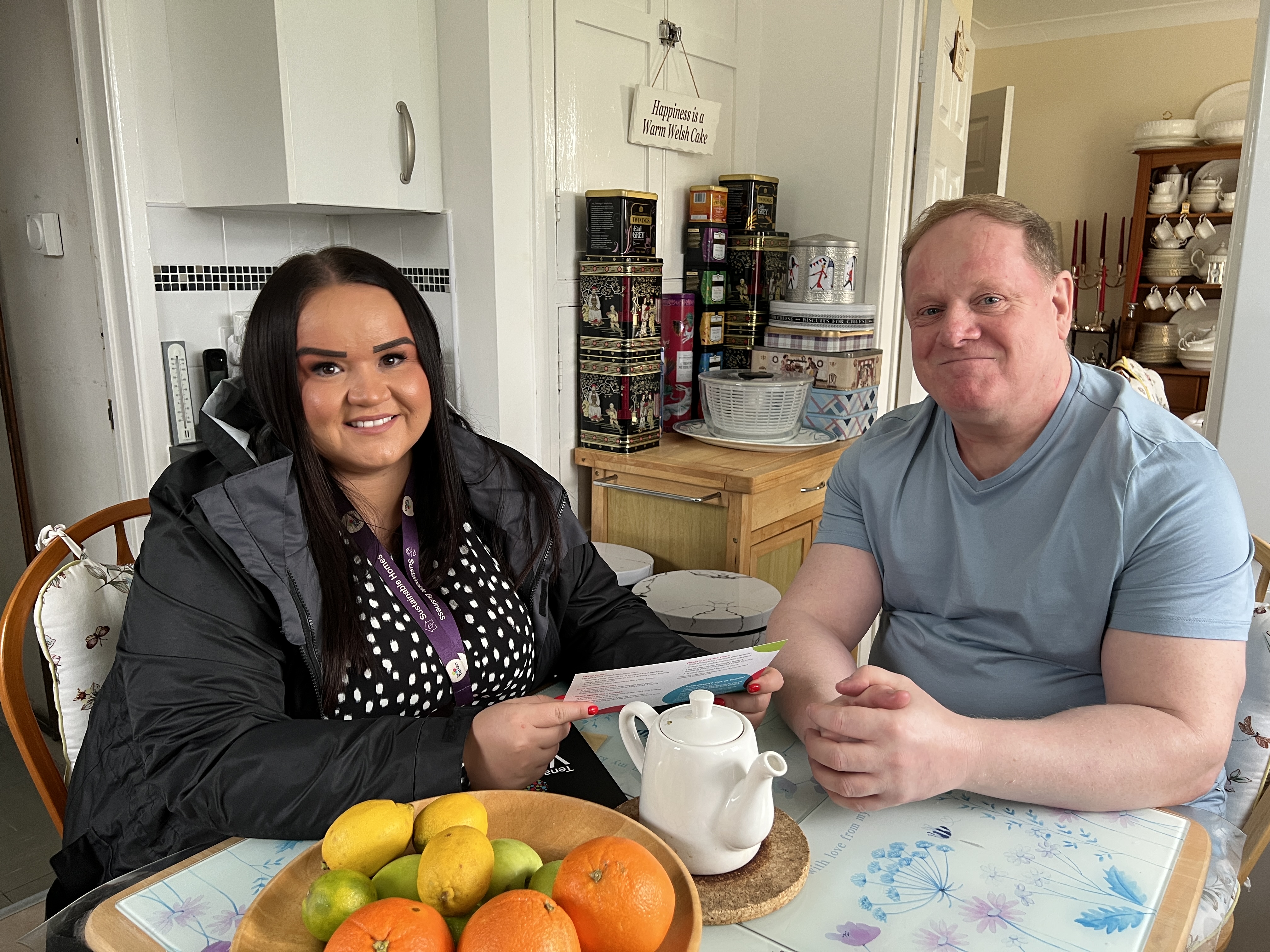
Building on what I said earlier though, an unintended outcome from my work which is harder to quantify or define, but certainly something that makes me proud is seeing the difference in the tenants I work with, and how they’ve changed because of their involvement with Tai Tarian. It’s seeing tenants from different backgrounds and with different lived experiences coming together and finding friendship and supporting each other that I find incredibly rewarding. Witnessing complete strangers become friends and bringing out the best in each other is a privilege. If I achieve nothing else during my time in housing, I’ll be proud of that.
What are the main challenges of the sector and the most pressing issues you face day-to-day? And how are you and Tai Tarian tackling them?
The Senedd elections in May changed the political landscape of Wales, in a way not seen since devolution began. Plaid Cymru have formed a minority government in Wales, which represents a challenge in itself, but the hard work begins now, the election was arguably the easy part (not that any part of politics is easy of course!). But a minority government represents uncertainty, at a time when the sector needs the exact opposite. One of the biggest challenges the housing sector in Wales faces is the implementation gap between legislators, operators and tenants and unless that is tackled head on then any changes introduced will be limited in their ability to drive better outcomes and crucially, meaningful social change.
It was encouraging to hear in June the Minister for Local Government, Housing and Planning, Sian Gwenllian MS confirm the Welsh Government’s intention to enshrine the Right to Adequate Housing into Welsh law, establish Unnos, a new development agency to assist in the creation of new social homes, and to explore how Welsh Government can introduce rent controls. However, a minority government means none of this is certain and the process to achieve any of this will be challenging and could potentially result in a watered-down policy, to appease and attract votes from across the chamber, resulting in worse outcomes for housing providers, tenants and the wider Welsh population.
Not only do we have a new party in power in Plaid Cymru, but we have 96 Senedd members now, a significant portion of whom have never held political office in any form before. This represents a unique challenge, unlike in housing where you can learn on the job, constituents expect their newly elected representatives to deliver immediate results and the change they voted for.
All of this comes at a time when there is increasing pressure on registered social landlords, in Tai Tarian alone, we average around 60 new applications for housing per week and in 2024/2025 of the 9,200 properties we own only 521 new tenancies were created. This is a huge challenge and is reflective of the wider housing crisis we face as a sector. Shelter Cymru research shows that there are more than 94,000 households currently on a waitlist for a social home, this equates to one in 14 Welsh households. But the reality of the situation is more than likely far worse than this.
Housing associations, including Tai Tarian have done incredible work in developing the supply of new, high quality, affordable homes. As a sector we should be proud that by the end of the calendar year we will fall only marginally short of the 20,000 new homes target at set out by the previous Welsh Government. Housing associations should be lauded for their delivery of this. However, from a national government perspective it has to be said that we must do more, this isn’t good enough. At the current rate, it will take 35 years to ensure supply meets the demand for affordable housing. We simply cannot wait that long. We are in an untenable position that as a nation over 10,000 people are trapped in temporary accommodation which is all too often unsuitable for their needs. All whilst private renters continue struggling to meet increasingly unaffordable rent and figures from Shelter Cymru put over 170,000 people on wait lists for social housing.
If Wales is to become the nation that ends homelessness and tackles the housing crisis head on, then we cannot build ourselves out. Land that is suitable for development as social housing is at a premium in Wales, particularly when we consider the long-term implications of climate change and how the landscape could change, as per the TAN15 maps. It’s not enough to simply build more homes on open parcels of land, we need to consider whether the people living them will have access to the resources required to live well, particularly when we consider that large portions of Wales still have inadequate public transport infrastructure. The homes we provide need to allow our tenants to thrive, not just survive.
The oldest housing stock in Europe is quickly becoming increasingly difficult to live in, manage and heat let alone support thriving, cohesive Welsh communities. That’s why the steps we take to decarbonise Welsh housing are so important. However, the manner in which we do this requires considerable and significant thought. In order for the decarbonisation of social homes to be a success, we must ensure it is done with tenants, not to them. Whilst social housing is leading the way in decarbonising homes, it is imperative that tenants help us co-produce the solutions to climate change if we have any hope in changing human behaviour as well as the homes themselves. By taking a place-based approach to decarbonisation, we can ensure that tenants and the wider community buy into the measures. The research project Tai Tarian participated in in partnership with Swansea University proved this. Tenants want to see an approach that encapsulates their lived experiences in their homes and the wider community.
The mantra nothing about us without us, is a well-founded approach in social housing and is a vitally important principle of our aim. I’ve heard first-hand the rising scepticism from tenants about the realities of climate change and the threat it presents, which when combined with increasing levels of misinformation poses a real threat to us delivering on carbon neutral targets through no fault of our own. But to tackle this, we need to work with our tenants in a truly collaborative manner, not forcing issues onto them which in turn risks intensifying negative experiences for tenants and has the potential to decimate trust. That is why it’s so important that we not only listen to what our tenants say, but how they say it and crucially what’s not said as well. We need to meet tenants where they are and not expect them to come to us.
In meeting the first iteration of WHQS, there was an established framework, which may have been a difficult road for some to take, but nonetheless the options were there. Such a clear mechanism for delivery does not exist for WHQS23. It is estimated that the government investment required to meet the new standards in the medium term is in the region of £4 to £5 billion (New Economic Foundation – Financing Welsh Housing Decarbonisation 2021). Whilst this has the potential to generate large economic returns, it also requires a different approach to long term funding. It will require new and innovative ways of leveraging funds. There appears to be a political appetite to harness the Development Bank of Wales in terms of developing housing, could this be extended to the retrofit programme?
The current short-term funding available for us, presents a huge challenge, both in terms of delivery and meeting tenant expectations. Longer term funding structures would allow us to give tenants greater clarity on programmes of work, increasing confidence in our ability to maintain and sustain existing homes. It would also go some way to help the sector tackle a growing sense amongst social housing tenants, that we only care about the new homes we build; not the tenants and houses we currently have.
All of this comes at a time when tenant rights have never been stronger and regulatory requirements have never been tighter, both of which are good things. People need to feel secure in their homes, which by and large they do in social housing, but such protection is not provided in the private rented sector yet. If the new Welsh Government can successfully end no fault evictions in Wales, then we will be closer to providing that much needed housing security which could in turn help reduce the pressure on homelessness services.
Increased regulatory scrutiny for registered social landlords though, in contrast to the light touch auditing that local authority housing providers and the lack of regulation the private rented sector faces is a challenge. As a social landlord, Tai Tarian and all other RSL’s have never been asked to do more whilst still ensuring that tenants are supported, rent remains affordable and that we remain financially viable and well run. We underwent our regulatory assessment under the new regulations recently and I’m incredibly proud that our regulatory judgement came in as green/green, which is not the case across the board in Wales.
In addition to all of this, we are currently in an age of technological advancement, where the role of artificial intelligence (AI) could change the lived experiences of tenants. In Tai Tarian alone, we are seeing how tenants are increasingly relying on AI to communicate with us, whether on day-to-day issues or on more serious and complex issues such as complaints. Whilst the technology is fantastic in its ability to allow tenants to communicate with us efficiently, it also presents a very real challenge in how it sets expectations and can often draw on legislation that is simply not relevant to Welsh social housing. The fine balancing act of embracing how AI could improve back-end systems and simplify process versus its impact on tenant facing roles is one that must be tackled very carefully.
Tai Tarian, like the rest of the housing sector is waiting, whilst doing what we can within the current structures to help deliver the best outcomes for our tenants. We continue to strive towards carbon neutrality, involving our tenants in that process one home at a time. We’re building new homes, housing new people, supporting existing tenants all whilst delivering on our core function of providing safe, affordable homes.
Despite all these challenges, housing in Wales is in a strong place and the best way for us to improve isn’t to dwell on what’s not working but look at our success and how we can use that elsewhere.
What's one thing in housing in Wales would you like to change?
Do I really have to pick just one thing? If so, then I’m picking the big one.
Wales needs a single, clear, coherent strategic vision for housing that encapsulates ALL of housing.
In order for any of the changes the new Welsh Government is looking to introduce to be worth the paper they’ll be printed on, then we absolutely must look at the entirety of housing. Otherwise, it will all be meaningless and in 10 years’ time we’ll still be asking ourselves the same questions, trying to tackle even bigger waitlists and even higher homelessness rates.
To me it seems like it’s no coincidence that the biggest social change in housing came at the hands of the Minister for Health and Housing. 80 years have passed since Aneurin Bevan’s vision of quality housing for mixed social community provided the bedrock for one of the greatest social policy provisions at size and scale in UK political history. He recognised that good housing is intrinsically linked to positive socio-economic, education and health outcomes. As the Minister of Health and Housing (1945–1951), Bevan spearheaded Britain's post-war housing drive. His vision prioritised high-quality, spacious homes integrated into mixed-income communities, ensuring housing was a public service rather than purely a commercial commodity.
"We should try to introduce in our modern towns and villages housing where the doctor, the grocer, the butcher and the farm labourer all live in the same street...in the living tapestry of a mixed community" those words are as true today as ever.
Granted much has changed in terms of social policy and fiscal challenges since then, but attributing development solely to historical decline overlooks the precarious position of Clement Attlee’s government in 1945, as well as the opportunities it identified and the incredible achievements they ultimately delivered together.
If we want to tackle the stigma so many who live in social housing face, then how better to achieve it than by returning to Bevan’s model? Admittedly doing so now isn’t as easy as it was then, given that large parts of the country required reconstruction post-war in 1945, but we should embrace the idea behind it. When we say homes for everyone, they should be for everyone.
Those who know me well, know how much of a cricket fan I am. In recent years the England and Wales Cricket Board, alongside Metro Bank launched the “Seeing is Believing” campaign which was based on the philosophy that you cannot be what you cannot see. The goal of the campaign was to close the representation gap in cricket encouraging more women and girls to take the sport up. We need the same, but in housing. If we don’t create and subsequently sustain communities showcasing what’s possible then we all but doom them to be stagnant.
As part of my presentation at TAI 2026 I spoke about how my grandparents’ lives changed following the allocation of their council house in a post-war late 1940’s Port Talbot. I spoke about how that house provided the foundation for my grandparents to live their lives free from the burden of worry about their home being taken from them because they couldn’t afford it. The security that home provided, allowed them to set up a successful florist in our hometown, a business which my mother later went on to run and was how my parents met. It also meant that they were able to send their other two daughters to university so they could become a teacher and a nurse respectively. That success is something we should be proud of. It also shows that when we get housing right, its impact is felt for generations. Perhaps one of the things we should look to change in a new strategy for housing would be looking at how we define success. Can we define success both in terms of the numbers; homes we build, homes we renovate and retrofit but also in terms of the impact of those homes, and the success stories behind each one?
The street my grandparents lived on had people from all walks of life living there and was the living embodiment of Bevan’s aim.
We need a robust strategic plan for housing, that recognises the nature of the interdependencies between social housing, private rented housing and home ownership. In doing so we can begin to address the stigma attached to social housing and create truly connected and cohesive communities. Welsh Government asked housing providers in WHQS23 to take a whole home approach, well let’s take a whole housing approach to housing and fix it together. It is only then that we can tackle rising homelessness and the effects that financialising housing has had on the sector.
It feels somewhat utopian to say this, particularly given how divisive politics feels at the moment, but we need the Welsh Government, UK government, political parties and thinktanks to put aside their ideologies and actually work together. A unified approach, which considers all elements of place-making more generally, from infrastructure, to access to green spaces, and economic planning which encourages businesses to operate in these communities will help to address many of the issues we currently face in housing. Crucially though, this must be done with tenants. It is often said that people who are closest to the problem have the best solutions and involving tenants in how we change housing can only result in positive outcomes. We need to use their expertise to deliver housing that works for everyone. In doing this, we could also provide our communities with new and exciting employment and training opportunities.
We know all too well that poor quality housing has health implications, which in turn increases demand on the National Health Service. Is the answer to this, a place-based approach where health boards and housing providers are given the tools to work together, ensuring one isn’t prioritised over the other so better outcomes can be achieved?
If all of this is considered under a new housing strategy then maybe we can make the Right to Adequate Housing a right for everyone in Wales, because then it won’t be a bolted-on addition, but rather it will ensure the legislation is anchored in solid foundation based on a systemic approach. This will mean that as a sector we finally have a whole system strategy that addresses supply, affordability and private rented standards. It is only with such an approach that Wales can achieve a housing system fit for all. One which leverages the economic benefits that building and renovating homes generates, that delivers on carbon neutrality, that provides a home for everyone and ensures that as a nation, we once and for all end homelessness.
What are your hopes and fears for the housing sector?
I accept that there are many priorities for change in the Welsh political landscape. Each priority is valid and each competes for scarce resources. However, we cannot say we are in a housing crisis and have any realistic hope of fixing the issues associated with it, whilst housing makes up for less than 5% of Welsh Government spend. Therefore, the status quo cannot be an option, and we cannot accept a short-term vision bound by a political cycle. If home really is the foundation for everything, from which lives are built and can be changed then is it really right that housing spend makes up for such small percentage of Welsh Government spend?
My hope is that with the momentous change that has taken place, politicians will have the courage to change the paradigm. 2026 has the potential in Wales to be a foundational moment for housing, just as 1946 was for the UK.
If Wales is to deliver on that bold vision for the future we set out in 2015 under the Wellbeing of Future Generations Act, which remains as a landmark piece of legislation globally 11 years later, then we absolutely must tackle the issue of homelessness. We cannot continue to allow Welsh citizens to live in unsuitable conditions and rely short term solutions like temporary accommodation when wholescale systemic change is needed.
Life is becoming increasingly unaffordable for Welsh citizens, which simply increases the pressure on an already stretched social housing system. Whilst it is not in the gift of the new Welsh Government to fix the cost of living crisis, some of the measures they have discussed, particularly exploring rent controls could go some way to helping alleviate the financial pressure so many, particularly those in the private rented sector, are facing. If we can look at housing as a whole, then we have a chance of fixing this.
Rural parts of Wales have a unique crisis of their own, with limited development opportunities for new homes and a private rented sector which prices the majority of residents out of the market, people are faced with limited options particularly when Welsh Government figures show that they have lower incomes compared to the rest of the UK.
It should come as no surprise, given my job, that one of my biggest hopes for housing in Wales is tackling the stigma surrounding social housing tenants. Stop Social Housing Stigma launched their campaign in April of this year to address what tenants experience as long-term, widespread and deeply felt stigma. Housing associations speak about how our tenants are the heart of what we do, or that we operate with them in mind, but this cannot be said whilst our tenants still experience stigma. The reality of their experiences is different to what we as a sector promote. Their report highlights how tenants feel a “that will do” mentality is adopted when working on their homes. Attitudes like that aren’t good enough and have no place in housing. Until attitudes like that are addressed and tenants experience a culture of care consistently, regardless of who they deal with, then I fear the situation in housing will only worsen. At a time when there is increasing division and harmful rhetoric around the provision of social housing, we need voices within the sector to champion our tenants. To speak about their talent, skills and the care and compassion they show for their neighbours and not allow the misconceptions surrounding social housing to develop any further. #
We need to work with our tenants to help tackle this issue, ensuring that they feel respected and valued and providing them a platform to push for meaningful change.
What does winning the Rising Stars award mean to you?
It’s a huge honour and something I’ll be proud of for the rest of my life in all honesty. When I was sent the presentation topic, ‘Why is it important that we have social housing in Wales?’, the question felt quite daunting, and I worried thinking how on earth could I answer a question like that in three minutes. I originally sat and looked at it from a wider context about the role of social housing, how it provides warm, safe, affordable homes whilst supporting some of the most vulnerable people in society, but then I realised that we were asked why it matters for Wales, and what makes Wales so special. There is so much for us to be proud of, particularly in social housing in Wales; from how we strenuously support our communities, how we work to protect future generations by improving homes and the ambitious aims we have as a sector.
To present at TAI2026 and speak about how a house is so much more than bricks and mortar was an honour. The opportunity allowed me to speak so personally, drawing on my grandparents’ example and how the allocation of their council house changed the trajectory of their lives, and ultimately mine. Following my presentation, countless delegates at the conference spoke to me about how that story resonated with them, that my grandparents’ story mirrored examples from their own family and I think it perfectly demonstrates how important a home is.
During the whole process, I kept saying to myself that being nominated by colleagues and being shortlisted was enough of a prize, and that I needed to make sure I enjoyed the opportunity to speak at TAI, and I wasn’t wrong. But to win the whole thing? That’s a feeling slightly harder to define. I was incredibly fortunate to have colleagues at the conference and dinner with me, and to celebrate the win with them felt special. I couldn’t have done any of this without their help and I hope they know just how grateful I am for their support, not just throughout this process, but every day as well.
Tai Tarian, like all social landlords are anchor institutions in their communities, but we’re reliant on incredible services that support our work as well. Homeless support services and charities are critical parts of the whole housing system and I’m incredibly grateful that I’ve been given the opportunity to shadow my local homelessness service as part of this process. When resources are as stretched as they are, it’s more important than ever that we appreciate what’s available to us.
To win the Rising Star Award and be recognised by peers as someone making a significant contribution to the sector is a privilege and I can only hope that I live up to the expectations that winning this award sets and become a trusted and respected representative for housing organisations, and crucially tenants in Wales.
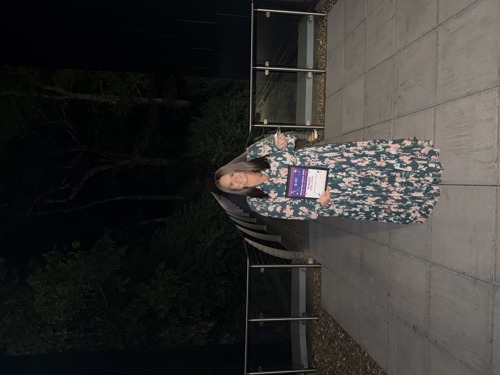
Katie is the winner of the Rising Stars Cymru award for 2026.