


In housing today, resilience isn’t a luxury; it’s a necessity. Because no matter where you are in your career, protecting your mindset and strengthening your resilience isn’t just important, it’s vital. Not only for ourselves, but for our tenants, our teams, and the future of our sector.
The Rooted in Resilience campaign is asking housing organisations and professionals to:
- Make wellbeing a strategic priority. By developing healthier workplace cultures - places where kindness is leadership, support is normal, and no one has to pretend they’re okay when they’re not.
- Harness the power of a growth mindset. Cultivating a growth mindset helps us stay curious rather than overwhelmed. By adopting growth mindsets as organisations and individuals it gives us the space to ask, “What can I learn from this?” and feel energised, supported, confident and connected in their work.
- Support a thriving sector. By building confidence and inclusivity across the sector, making sure every housing professional, at every stage, feels valued, supported and able to grow.
Rooted in Resilience toolkit
The toolkit resources provide individual and organisational tools to help embed mental wellbeing into our personal development, team culture and leadership, so we can better serve our communities while looking after one another along the way.
Team culture and resilience checklist
A practical tool for team leaders to strengthen resilience, psychological safety and continuous learning.
Psychological safety
- Team members feel safe raising issues or concerns without fear of blame.
- Mistakes are treated as learning opportunities.
- Difficult conversations are handled openly and respectfully.
Communication and trust
- Regular check-ins are in place (1:1s, quick team huddles).
- Team behaviours reflect shared values and professionalism.
- Feedback flows in all directions – leader-to-team, team-to-leader, peer-to-peer.
Learning and reflection
- Debriefs occur after high-pressure periods or major tasks.
- Lessons learned are captured and applied to future work.
- Team members have access to development opportunities.
Collaboration and support
- Peer-support moments are built into workload.
- Team members proactively help each other with challenges.
- Recognition and appreciation are part of day-to-day culture.
Innovation and problem-solving
- Space exists for ideas, creativity and solutions.
- Innovation forums or quick ideation sessions are part of routine practice.
- Team members feel confident to make suggestions or challenge existing processes.
Choose a few to embed consistently.
- Weekly 10-minute peer check-in: “How are we doing? What support do we need?”
- Weekly reflection moment: Each person shares one win and one challenge.
- Monthly ‘What worked / what we learned’ session: Capture insights and build knowledge.
- Quarterly innovation sprint: Identify one process to simplify or improve.
- End-of-week resilience reset: Team shares what helped them stay grounded.
- Rotating ‘team wellbeing lead’: Light-touch role to champion small resilience habits.
Define three to five indicators to track team wellbeing, culture and capability. Examples:
- Number of peer-support conversations held per month
- Percentage of team attending ‘opportunity identification’ or innovation sessions
- Frequency of debriefs after stressful periods
- Participation in reflective practice or development sessions
- Team pulse feedback results (e.g., psychological safety score)
Write one commitment you will uphold to strengthen resilience in your team.
Remember: Resilient teams don’t happen by accident. They are built through intentional habits, leadership behaviours and consistent cultural signals. Use this checklist monthly to track progress and strengthen your team’s collective resilience.
Wellbeing and mental resilience mini guide
A practical companion for housing professionals to use individually and for peer support.
Why wellbeing and resilience matter in housing
Housing professionals work with complexity, pressure, and emotionally demanding situations every day. Supporting tenants in crisis, navigating policy and regulatory change, and working within resource constraints can take its toll.
This mini-guide offers simple, evidence-based tools to help strengthen mental wellbeing, protect energy, and buildpersonal and professional resilience.
Put your own oxygen mask on first: Recognising stress early
- Feeling overwhelmed or mentally “foggy”
- Irritability, frustration, withdrawing from others
- Difficulty concentrating or making decisions
- Physical signals: headaches, poor sleep, tight muscles
- Feeling unusually tired or emotionally flat
- What emotion is dominating today?
- Is this stress short-term or building over time?
- What one thing would lighten my load right now?
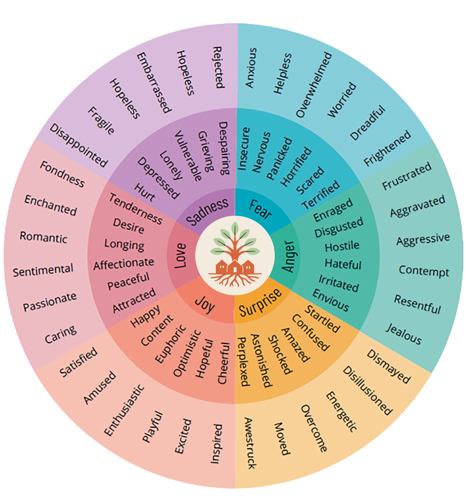
Feelings wheel
A feelings wheel is a visual tool that helps people identify and describe their emotions in more detail, moving beyond simple labels like “happy” or “sad.” Breaking emotions into more specific categories can support greater self-awareness and better emotional intelligence.
By pinpointing exactly what we’re feeling, it becomes easier to understand the root of an emotion and respond to it more effectively, helping us navigate emotional challenges and communicate more clearly.
Sitting with emotions
Once you’ve identified an emotion, it can be beneficial to sit with it and truly understand where it comes from. Key benefits include:
- Enhanced emotional intelligence
- Improved mood and minimised experience of anxiety (when practiced regularly)
- Improved emotional regulation
- Strengthened resilience
- Improved mind-body connection
- An increase in self-understanding
The simple steps below can help you to sit with and regulate your emotions, which can in turn improve your overall mental wellbeing.
Start by labelling what you’re feeling. You can begin broadly and narrow it down using the feelings wheel (e.g. from “angry” to “frustrated” or “resentful”). Simply naming an emotion can help reduce its intensity.
Pay attention to where the emotion shows up in your body, such as a tight chest, a knot in your stomach, or tension in your shoulders. This helps connect your thoughts with your physical experience.
Ask yourself simple, non-judgemental questions to better understand the
emotion:
- How strong is it (0–10)?
- Did it come on suddenly or build over time?
- Does it feel familiar?
- Is it linked to something recent, or something older?
Consider what the emotion might be telling you. Is there a helpful action you can take, or is this something to acknowledge and let pass? Not every feeling needs a solution. Sometimes noticing and allowing yourself to feel an emotion is enough.
Taking the time to identify your emotion can reduce its intensity.
Building everyday resilience habits
Take two minutes to reset your nervous system:
- Deep breathing
- Stand, stretch, drink water
- Step outside for one minute of fresh air
- Set a clear “end of day” ritual
- Schedule protected focus time
- Reduce out-of-hours communications
- Say “I can do that tomorrow” when appropriate
Short activities that help you reset:
- A short walk between meetings
- Writing down what’s bothering you
- Listening to a wellbeing or mindfulness track
- Chatting with a trusted colleague
Check out the Rooted in Resilience practical mindful activities and resources for inspiration.
Reflect weekly:
- What impact did I have this week, even if small?
- Where did I help someone feel heard or supported?
Resilience grows when we connect our work to purpose.
I noticed what you did there, and it made a difference because...
Peer-support techniques (for colleagues or buddy pairs)
The three-layer check-in
- How are you? (the surface)
- How’s your energy? (stress level)
- What’s one thing you need today? (actionable)
Ask before you advise
Try: “Do you want me to help solve this, or just listen?”
The ‘next small step’ method
When things feel overwhelming:
- Identify the smallest useful action
- Commit to one small movement, not the whole solution
Active appreciation
A simple formula: This builds confidence and resilience across the team.
Try: “I noticed what you did there, and it made a difference because…”
A reflection workbook
A personal toolkit to strengthen mindset, adaptability and professional resilience.
How to use this workbook
This interactive workbook is designed to help you reflect on your strengths, identify areas for growth, and build habits that support resilience in your professional life. Work through each section at your own pace. Return to the prompts regularly to notice patterns, progress, and new insights.
Resilience is not about being unaffected — it’s about being resourceful, reflective and ready to learn. The strongest professionals are those who grow through change, not just endure it. Use this workbook as a companion on that journey.
Self check
- What beliefs guide how I approach challenges in my work?
- Do I tend to see setbacks as temporary or defining?
- When faced with difficulty, do I look for root causes, opportunities, or someone to blame?
Reflection prompts
- Describe a recent challenge that stretched you most. What did you learn about yourself?
- When did you last surprise yourself with your own capability?
- What mindset do I want to strengthen over the next month?
Self check
- How do I typically respond to change - curiosity, anxiety, resistance, motivation?
- Do I wait for change to be imposed, or do I actively look for ways to adapt?
Reflection prompts
- When have I shifted from reacting to proactively shaping an outcome?
- What’s one change I initially resisted but now recognise as beneficial?
Self check
- Am I able to spot opportunities even in difficult situations?
- Do I feel confident suggesting new ideas, or do I hold back?
Reflection prompts
- Describe a moment when a setback revealed a new opportunity.
- What untapped strengths or resources could I draw on more often?
Self check
- When things go wrong, do I analyse what happened and why?
- Do I actively seek feedback? How do I tend to respond when I receive it?
Reflection prompts
- What skill have I strengthened most in the past year?
- What did a difficult mistake teach me?
- What is one area of knowledge or practice I would like to develop next?
Self check
- Do my colleagues feel able to approach me for support?
- How do I contribute to psychological safety in my team?
Reflection prompts
- When did I last help someone regain confidence or navigate a challenge?
- What can I do to model resilience for others?
Weekly action plan
Each week, commit to one small, practical action to strengthen your resilience.
This week’s intention
I will…
| Build openness to change by: | |
| Strengthen my mindset by: | |
| Look for opportunities by: | |
| Support others by: | |
| Commit to my growth by: |
End of week reflection
- What did I notice about my reactions, mindset, or energy levels?
- What worked well? What was harder than expected?
- What’s one thing I want to carry forward into next week?
Monthly review
Progress check in
- What resilience habits have I strengthened this month?
- What themes have emerged from my reflections?
- Where am I seeing progress in confidence, adaptability or leadership?
- What do I want to focus on next month?
Personal resilience statement
Write a brief statement capturing what resilience means to you and how you intend to live it in your daily practice.
Practical mindful activities and resources
The following section has some simple mindfulness activities and resources to help you find calm, and practise self-compassion during your day.
Check out the links to short videos on different relaxation techniques, some simple breathing exercises to try, and links to one minute mindfulness podcasts.
When things feel overwhelming it’s important to be kind to yourself. Remembering the four key components of selfcompassion, whilst practicing the relaxation techniques in this booklet, can help.
Your reminder of the four steps to self-compassion:
- Awareness: Being attentive and aware of the fact that suffering is occurring.
- Normalising: Recognising that what we experience is universal and not our fault.
- Kindness: Approaching the pain felt with kindness and understanding.
- Alleviation: Taking action to alleviate the suffering through comforting and caring actions.
Get inspired by this short animation from Mind with eight relaxation tips for your mental health: https://youtu.be/cyEdZ23Cp1E
There are lots of wellbeing apps. Some promote healthy habits and wellbeing prompts to help integrate wellbeing into your daily routine. Mind have created an app library of safe, trustworthy mental health apps.
There are many different podcasts and audio downloads to strengthen your mental wellbeing.
Here are two that are free and easily accessible:
- The mindful minute
- BBC’s Help Me Relax one minute podcast updated weekly
There are many different breathing exercises. We’ve selected two that take just a few minutes and can be done anywhere when feelings of stress, anxiety and panic rise.
Chosen to be discreet, these calming breathing techniques can easily be done at your desk, or as part of your working day.
Energising breaths
This is a great exercise to make you feel more energised and alert
- Take a couple of deep, slow breaths to ground yourself
- Now breathe in, through your nose, for four short sharp breaths (do these back-to-back)
- Then exhale in one long slow breath
- Repeat five times.
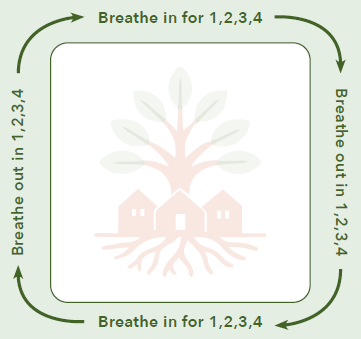
Box breathing
- Breathe in for four seconds, while tracing one side of the box.
- Breathe out for four seconds, while tracing the next side of the box.
- Breathe in again for four seconds, tracing the third line of the box.
- And out for four seconds while tracing the last side of the box.
One-minute grounding meditation
This is a simple exercise to centre yourself, tune in to the sensations in your body, and engage with your environment.
Practise it throughout the day, especially any time you find yourself getting caught up in your thoughts and feelings.
- Sit down in a comfortable position
- Plant your feet into the floor
- Push them down - notice the floor beneath supporting you
- Notice the tension in your legs as you push your feet down
- Now shift your attention to the feeling of your body in the chair and the feeling of gravity flowing down through your head, spine, and legs into your feet
- Now expand your awareness back to the room you are in. Take a second to notice what you can see and hear around you
- Notice where you are and what you’re doing, then gently go on with your day.
One-minute awareness meditation
This exercise shifts focus from the current sensations in your body to your immediate environment.
This is a great exercise to practice throughout the day and is particularly helpful in those moments you may feel overwhelmed and caught up in your worries and feelings.
You can complete this exercise while sitting or standing.
- Pause what you are doing for a moment
- Look around you and notice five things you can see. As you notice them, silently name them in your mind
- Now shift your attention back to your environment and notice five things you can hear. Again, gently naming them in your mind
- Finally, notice five things you can feel in contact with your body, and continue to name them gently to yourself. You may, for example, notice the watch against your wrist, the air on your face, your feet upon the floor, your back against the chair, and your shirt against your skin
- Now gently bring your attention back to what you were doing and proceed with your day mindfully.
Taking one minute to pause and rest your mind can boost your resilience for the rest of the day