

17 Sept 2026
CIH Cymru response to consultation on priorities for the Health and Social Care committee
Introduction
Housing is a key social determinant of health. A lack of housing or poor-quality housing can negatively affect health and wellbeing. Having a safe, suitable and affordable home can reduce financial stress, increases opportunities to engage with a wider community and enables individuals and families to invest in social ties. Which when considered can significantly improve the health and wellbeing of individuals.
As housing is a key determinant of health and a key driver in improving health outcomes for individuals, a safe, affordable and sustainable home must be clearly identified as a key component of any work aimed at improving the health outcomes for people living in Wales.
Housing providers are a key partner in supporting timely hospital discharges.
A lack of suitable, safe and affordable housing in Wales is contributing not only to rising homelessness and the use of temporary accommodation, but also to delays in hospital discharge. This particularly affects older people with mobility issues, people with mental health needs requiring supported accommodation and those who remain homeless when leaving hospital. Delayed discharge can harm recovery and reduce hospital capacity, highlighting the importance of secure housing and appropriate community support.
While housing associations recognise the importance of timely discharge, members report that hospital discharge guidance is not always followed. Examples include people being discharged into homelessness with little notice or information, and individuals returning to supported accommodation without providers being informed that their support needs had changed during their hospital stay. Members have also reported difficulties with underused step-down accommodation due to poor communication and referral processes between health and housing services.
Housing associations can access the Physical Adaptations Grant to fund adaptations such as accessible bathrooms, hoists and handrails, helping people return home safely. However, annual funding caps have reduced available funding, with one member reporting a 30% reduction in grant allocation. At the same time, demand remains high and rising material, labour and subcontractor costs have reduced the number of adaptations that can be completed. One provider saw funded adaptations fall from 132 in 2021/22 to 96 in 2023/24.
Research from Care & Repair Cymru highlights that rising adaptation costs and supply chain pressures are increasing waiting times for essential works, with implications for health, wellbeing and hospital discharge. For example, the cost of plasterboard, steel and bathroom adaptations has risen significantly in recent years.
Housing associations remain committed to working with health boards and social care partners to support timely discharge and independent living. However, housing must be recognised as a core part of the health and care system, with sufficient funding for adaptations, accessible housing and support services. Similar support is also needed for owner-occupiers to adapt their homes and reduce the risk of hospital readmission. Housing is a key determinant of health and investment in it can deliver significant benefits for individuals and public services alike.
- How effectively are current hospital discharge arrangements integrating housing, health and social care services, and what changes are needed to ensure discharge guidance is consistently followed across Wales?
- Does the current level of funding for housing adaptations and accessible housing adequately support timely hospital discharge and independent living, and what assessment is needed of the wider costs to health and social care services because of underinvestment in these areas?
- How can the Welsh government and health boards strengthen joint planning and accountability with housing providers to ensure that supported accommodation, step-down provision and community based support are fully utilised and aligned with local need?
Mental health support for the housing workforce needs investment
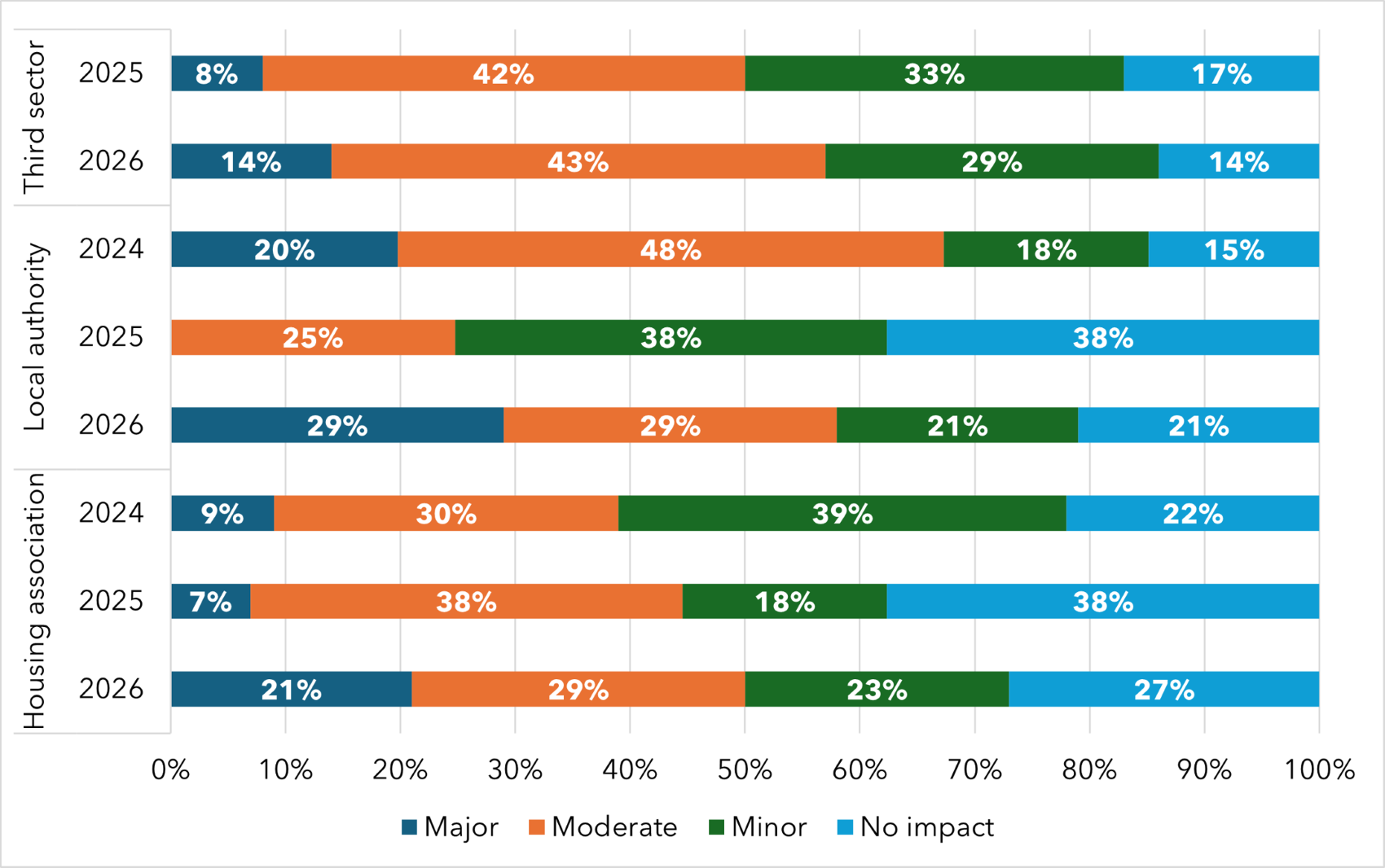
CIH Cymru's annual sector snapshot surveys consistently highlight a workforce under increasing pressure from growing caseloads, more complex needs and shrinking resources. Housing professionals are increasingly filling gaps left by reductions in other public services, particularly mental health support. As a result, they are often the first to respond to people in crisis but lack access to the specialist services needed to provide effective support.
The combined impact of high workloads, resource constraints and exposure to vicarious trauma is taking a significant toll on workforce wellbeing. As shown in figure one, survey results show a sharp increase in the proportion of housing professionals reporting a major negative impact on their mental health, with particularly marked rises in the housing association, third sector and local authority workforce.
This is reinforced by research from the University of South Wales, which identified a clear need for psychologically informed approaches, greater organisational support for wellbeing and work-life balance and training focused on psychological safety, burnout, vicarious trauma and reflective practice.
Building a resilient and valued workforce is a key commitment within the Ending Homelessness Action Plan. However, our sector snapshot surveys suggest that this ambition has yet to translate into meaningful improvements for many housing professionals. Greater investment in workforce wellbeing, training and support is needed to ensure staff can continue delivering vital services while protecting their own mental health and resilience.
- How can housing, health and social care services work more effectively together to ensure housing professionals are not routinely required to fill gaps left by reductions in specialist mental health and other support services?
- What actions should the Welsh Government, housing organisations and partner agencies take to improve workforce wellbeing and resilience across the housing sector, including embedding psychologically informed practice, training, supervision and support for staff experiencing burnout and vicarious trauma? Also, how should progress be measured and reported to ensure meaningful change for those in customer facing roles?