

22 Jan 2026
CIH responds to the Greater London Authority’s consultation on ‘Support for housebuilding’
We welcome the opportunity to respond to the Greater London Authority’s (GLA) consultation on ‘Support for housebuilding’.
At CIH, we support the government’s ambition to build 1.5 million homes in this parliament, particularly with a focus on delivering social housing. Housebuilding has failed to keep pace with demand for years, with rising levels of homelessness.
We know that the current environment for developing homes may be restraining the ability to achieve 1.5 million new homes. As outlined by the Regulator of Social Housing’s Sector Risk Profile 2025, the ability for social housing registered providers to develop new homes has been limited due to the increasing costs for existing homes and a changing regulatory environment, with “difficult trade-offs” for providers. There are specific constraints in London, such as a greater spend on fire safety remediation and building safety legislation with a higher density of flats, as outlined in the UK Housing Review Autumn Briefing 2025. There are also challenges for the wider housing market, with external influences such as economic events and high interest and inflation rates all having impacts upon the supply chain, labour cost inflation, and viability.
We therefore understand the aim to boost the delivery of housebuilding in a difficult economic landscape. However, we believe some of the measures outlined in the consultation will have a detrimental impact on affordable housing delivery in London at a time when it is needed most. These proposals will not adequately resolve the challenges and may have long-term negative impacts upon affordability in the capital. This summary response outlines these concerns on the following key areas (with reference to the relevant question number):
- Affordable housing requirements in the time-limited planning route
- Other issues to address such as the Building Safety Regulator and use of land
- Wider concerns on the impact outside of London
We welcome the opportunity to speak with the GLA and MHCLG further about our response.
Questions 4, 5, 6 and 10
Context (Questions 4 and 5)
As outlined above, we understand the need to address the slowing down of housing delivery in London, which has been described as the capital’s “largest challenge since the Second World War”. The 2017 Strategic Housing Market Assessment (SHMA) provided a target of 42,841 homes a year:
- In 2023/24
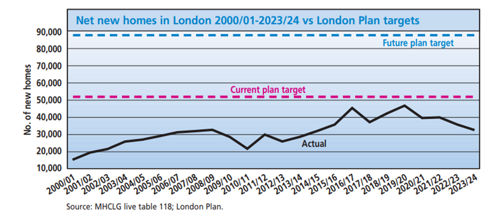 UK Housing Review Autumn Briefing 2025 , using information from MHCLG live table 118; London Plan.
These figures clearly do not address the high housing needs in the capital. The lack of affordable housing supply is directly linked to the number of people experiencing homelessness. Analysis by London Councils in December 2025 estimated that 210,000 Londoners are homeless and/or living in temporary accommodation, which includes 102,000 homeless children. This is rising and costs London boroughs £5.5 million a day. It is not acceptable that increasing numbers of people, including children, do not have a safe and affordable place to call home, and it is clear that affordable housing is an urgent need in the capital to tackle these concerns. The latest evidence base for the London Housing Strategy monitoring indicators supports this, stressing the importance of increasing the stock of social housing, as well as making housing more affordable and reducing homelessness.
It is these high levels of housing needs that are most at risk of not being met through the consultation proposal of the time-limited planning route. The lowering of affordable housing requirements from 35 to 20 per cent demonstrates a clear reduction in homes being built to meet the real needs of Londoners, where lack of affordability is a key issue. The London Plan 2021 outlined a strategic target for 50 per cent of new homes across the capital to be genuinely affordable. The threshold approach to viability in the plan lowers this to a minimum of 35 per cent affordable housing through a fast-track route to speed up delivery. The fact that this already-lowered threshold route of 35 per cent affordable housing needs further support in these proposals shows that this method of incentivising speed with less affordable housing does not work at the scale needed.
Whilst we understand “35 per cent of nothing is nothing”, we would argue that the long-term impacts of reducing affordable housing must be fully explored. The incentives to developers to lower these targets bakes in an expectation that approvals with lower affordable housing proportions will be accepted and strengthens the argument that affordable housing will always be the first to be removed due to viability, which has been argued within varied economic and market conditions over time, particularly in London. The limitation of affordable housing requirements by private developers should be the last consideration when all other options have been exhausted. As this response outlines, there are other avenues to improve housebuilding in London such as reforming the Building Safety Regulator and reviewing land use, which must be tried and tested first. The long-term impact of these changes will result in lower affordable housing delivered through the private sector, higher rates of unaffordability in the capital, and increased risks of homelessness. If these changes are to be implemented, we would stress the need for these to be time-limited and narrow in scope, to ensure that affordable housing continues to be a priority in London and meet rising housing affordability needs.
CIH has consistently stated that new homes must meet local needs. We are concerned that by reducing affordable housing requirements, the homes boosted through to completion will be unaffordable homes that will not meet the needs of most Londoners. This will meet the requirement of building homes to meet targets, without regard to the types of homes being built and if they are fulfilling local needs.
Across the country, from large-scale developments, like new towns, to smaller rural exception sites, we must ensure that all new homes are affordable, safe, of good quality and fit for the future with sustainability and accessibility requirements. Without this focus, we will build homes that people do not want, cannot afford, or do not meet their support needs. By reducing the need for the private sector to contribute to building much needed affordable homes, we are losing the opportunity to tackle these rising needs and focus on targets and profit over people and communities. As noted by Nye Bevan in the post-war period: "We shall be judged for a year or two by the number of houses we build. We shall be judged in ten years time by the type of houses we build".
Timelines and build out rates
If these measures are implemented, we agree with the limitation of these proposals until 31 March 2028, or publication of the revised London Plan. This will reduce the impact of these proposals and ensure that it does not become a long-term strategy to limit affordable housing delivery in London.
It is vital that these changes are a temporary measure, and that the new London Plan does not further limit affordable housing development and continues with ambitious expectations for all those who wish to develop in London to meet local needs. There must be clear timelines and guidelines for reverting back to the 35 per cent affordable housing target, and we look forward to seeing this restored, at a minimum, in the upcoming London Plan.
For the GLA and MHCLG to adequately address the slowing delivery of housing, it must also review and monitor build out rates. The working paper ‘Speeding Up Build Out Rates’ highlighted government’s concerns in this area. It is crucial that all partners within the housing space play their part in building the homes we need at the pace we need them, and this includes the role of developers in building out homes and addressing concerns raised throughout the sector of land banking. For more detail, please see CIH’s written evidence to the working paper.
On this point, the consultation rightly outlines the importance of having a deadline of 31 March 2030 for construction to meet fixed milestones to benefit from the proposed changes or apply a ‘gain share’ mechanism. However, there are still concerns around these changes. It is unclear how these milestones will be measured, and by whom, and the role of flexibility and negotiation in this. For these significant benefits to result in the required delivery, there must be clear accountability and transparency in reviewing construction timelines, and measures consistently implemented when these are not met.
Existing schemes (Question 10)
A further concern raised by the proposals is for schemes that are already through the planning process, and subsequent re-applications or reviews of existing schemes. The consultation encourages the delivery of above 20 per cent affordable housing where schemes are further along in the process. Yet, it also allows for the renegotiation of existing Section 106 agreements with viability concerns to deliver “at least the relevant level of affordable housing established in the new planning route”. This appears to provide a loophole for developers to renegotiate existing Section 106 agreements under ‘viability’, which is both time and resource intensive for local authorities, and will deliver less affordable housing than initially required. Instead of achieving the aim of speeding up the delivery of homes, this process will increase timeframes, slow down development until renegotiation has completed, and may also lead to increasing numbers of legal cases.
Use of grant (Question 6)
There are concerns in the sector that the proposed use of grant funding by private developers, including the new Social and Affordable Homes Programme, will ‘eat away’ at the funding provided for direct delivery from registered providers. The sector warmly welcomed the £39 billion programme when announced in 2025, as it was proposed to support local authorities, housing associations and other sector organisations to build much needed affordable homes.
Yet, the use of this funding to ‘reward’ schemes providing lower numbers of affordable housing due to viability provides a ‘double discount’ and may impact on the availability of grant funding for social housing providers. Through the proposals, developers could reduce their provision of affordable housing due to viability concerns (saving money), and then also use grant funding to subsidise the provision of affordable housing. In the London Plan 2021, it was clear that the minimum threshold of affordable housing must be delivered without grant or public subsidy. The consultation has now changed this to allow for grant funding to be used on any affordable housing past the first 10 per cent. It is crucial that the opportunity to support direct delivery from the social housing sector is not hindered by the loss of grant funding through this mechanism, and that the sector is fully enabled to build, maintain, and support residents of social homes.
Integrated Impact Assessment
The Integrated Impact Assessment (IIA) accompanying this consultation acknowledges that not fulfilling housing targets will have negative effects for those in need of affordable housing, especially for many people with protected characteristics. This is used to justify the proposals, in order to increase housebuilding to meet targets. The IIA states “Boosting delivery is considered unlikely to result in any negative impacts on sustainability, health or community safety”. Yet, boosting the delivery of unaffordable homes which do not meet local needs will not benefit the community, and may result in increased numbers of people living in temporary accommodation or sleeping rough, due to the lack of affordable housing in the capital.
Whilst we understand the concern in the IIA of applications being granted, often through appeal, with even lower levels of affordable housing, lowering targets cannot be the only solution. As stated in this response, the long-term impacts of reducing good quality, affordable housing will have wider negative impacts, and it must be considered within the IIA what types of homes are being built, and their more holistic positive or negative impact. We recommend that the GLA review the IIA in light of these long-term impacts, rather than short-term ‘quick wins’ that may have long-lasting negative effects on affordability.
Building Safety Regulator
As discussed, we are aware of the challenges associated with reduced housing delivery in London. Whilst we do not agree with all the proposals in this consultation, it is clear that changes are required to boost delivery.
From discussions with our members and the wider sector, the role of the Building Safety Regulator (BSR) is crucial in improving the delivery environment in London. As detailed in our response to the BSR inquiry in summer 2025, the BSR must have the clarity, capability and cultural tools to succeed, and there are currently barriers within this process which are impacting housebuilding. We welcome the government’s commitment to improving the performance of the BSR, which will have a significant impact upon delays and viability concerns of housebuilding in London. At present, the delays, lack of communication and guidance, and high levels of rejections from the BSR have significantly delayed housebuilding in the capital, which has a higher proportion of tall buildings within scope. The Industry and Regulators Committee inquiry report called these delays “unacceptable” in December 2025, and also linked these delays to potentially missing the government’s 1.5 million homes target.
Yet, it is vital that these recognised issues with the BSR do not extend to wider conversations about scaling-back building safety requirements in housing, particularly not to protect ‘viability’ arguments. CIH has consistently made clear that while aspects of the BSR’s operation may need to change to improve delivery, this must not extend to scaling back wider building safety regulation. Across our several responses to consultations and calls for evidence, we have consistently advocated for stronger duties, clearer enforcement, and full delivery of the post-Grenfell reforms.
Our policy work has highlighted concerns around organisational capacity, clarity, and consistency in implementation, rather than any case for reducing standards or narrowing the scope of building safety regulation. This position is reflected across our work on construction products and cladding remediation, where we have supported broader regulatory scope, clearer accountability, and enforcement that directly improves resident safety. Most recently, in responding to the next phase of implementing the Grenfell Tower Inquiry recommendations, we explicitly supported reform focused on improving processes rather than changing standards, to maintain safety while addressing delivery and capacity concerns.
Rather than reducing affordable housing targets with the hope this will deliver more homes, even if they are not affordable or meeting local needs, CIH advocates that the solution-focused approach outlined to ensuring that the BSR is effective will do more to boost housebuilding in the capital than reducing affordable housing targets for private developers.
Use of land
There are other mechanisms highlighted both in this consultation and in wider government reforms which can further tackle the lack of housebuilding in London. One of these is the government’s plans for the green belt, and the introduction of ‘grey belt’ land, which particularly limits development around London. The Mayor of London’s plans for exploring the release of London’s green belt demonstrates new opportunities to build much needed homes, and should be explored further before reducing affordable housing thresholds.
Another crucial element is the use of land, and land prices more generally. The UK Housing Review Autumn Briefing Paper 2025 outlined the significance of public land in the capital, with Transport for London owning 5,700 hectares alone. There are opportunities to boost housing delivery on public land in London, including through direct delivery by boroughs and housing associations. The government’s recent proposals to speed up housebuilding around ‘well-connected’ rail stations can assist with this, as outlined in the latest National Planning Policy Framework consultation. Lichfields concluded that the proposed rail stations policy could provide around 632,600 homes nationwide, which would be a significant boost to housebuilding, particularly as many areas within London are likely to fall within the ‘well-connected’ definition.
Community Infrastructure Levy (CIL)
Whilst we are aware that many of the proposed changes on the Community Infrastructure Levy (CIL) are in the MHCLG consultation, we wanted to highlight our concerns collectively and holistically. Some of the key sector concerns with the proposals raised are:
- The relief from CIL is a direct benefit for private developers, and there must therefore be clear, transparent monitoring of how subsequent housebuilding will be measured, and accountability for delivery targets.
- The removal of CIL from boroughs may have unintended consequences. In the majority of cases, CIL has been allocated or earmarked for future projects to benefit the community. We have also heard that CIL can be used to help boroughs fund planners, which are a vital part of boosting housebuilding and in desperate lack within local authorities, and increasing relief opportunities from CIL may have impacts upon local planning teams’ ability to approve housebuilding applications.
- Finally, CIL is meant to be a simple process, and these changes will make it more complex for boroughs to review viability assessments and calculate CIL relief. This will increase time and resources to process planning applications, having a negative impact.
Wider impacts beyond London
CIH noted in our initial reaction to the London housebuilding announcement of concerns for the wider impact of these changes. Whilst the consultation itself is specifically focused on London, there could be a clear case for other areas of the country to make similar arguments regarding viability to lower affordable housing requirements in their area. This may be to genuinely boost housebuilding, but it also may be to appear more appealing to developers, as the London changes could be an incentive for developers to focus delivery in London more prominently for viability and profitability. We do not want to skew the housing market by providing incentives to not build elsewhere in areas with high housing need outside of London. We also do not want a cascade of other areas lowering affordable housing requirements, to ultimately lower the overall delivery of genuinely affordable housing in this country, at a time when it needs it most. The impacts of these proposals may be felt beyond just London and the scope of the GLA, and we are concerned of the precedent that may be set by these emergency measures.
For more details on the consultation visit this webpage.
For more details on our response please contact Megan Hinch, policy manager, megan.hinch@cih.org.