

14 Aug 2026
CIH Scotland response to the Finance Committee pre-budget scrutiny consultation
Housing provides the foundation for people to thrive. Poor quality housing impacts our health and wellbeing, homelessness stifles educational attainment and employment opportunities, limiting people’s ability to contribute to society, increasing poverty and inequality. Failing to meet people’s housing needs risks prolonging the existing housing emergency. It will increase costs for the NHS and other partners.
Housing is essential to our economy and should be central to the Scottish government’s long-term spending plans.
Housing supply
The Scottish government’s planned investment in affordable housing supply will not meet identified housing need and risks failing to reduce homelessness or tackle the housing emergency. This will result in increased spending on expensive crisis intervention including temporary accommodation and healthcare associated with homelessness and inadequate housing.
The Scottish government must increase Affordable Housing Supply Programme (AHSP) funding in line with independently identified need or risk increasing spend on homelessness and related health issues.
The 2026 Spending Review reiterates the Scottish government’s commitment to invest £4.9 billion over four years (an average of £1.23 billion annually) to support the delivery of 36,000 affordable homes. This equates to 9,000 homes per year which falls far short of the Scottish government’s own target of delivering 110,000 social and affordable homes between 2022 and 2032, which would average 11,000 homes per year.
It is even further from meeting the figure of 15,693 social and affordable homes per year identified by independent research commissioned by CIH Scotland, Shelter Scotland and SFHA ahead of the election.
The chart below shows the number of social and affordable homes completed through the Scottish government’s Affordable Housing Supply Programme (AHSP) up to 2025/26 (the latest data available) compared to the average of 11,000 completions per year required to meet the Scottish government’s own target and the 15,697 homes required to meet the need identified by our affordable housing research.
Chart 1: Number of AHSP completions compared to Scottish government supply target and affordable housing need identified by CIH, Shelter and SFHA research
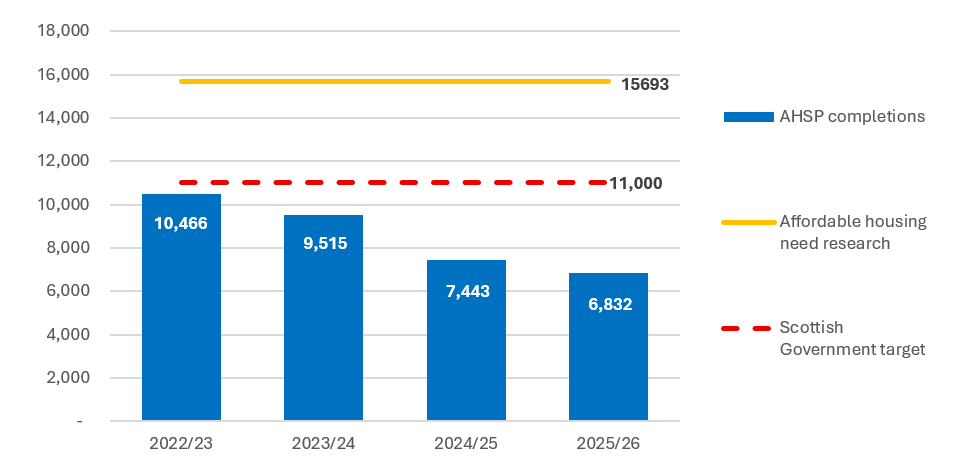
Source: Affordable Housing Supply Programme summary tables financial year completions, Scottish government affordable housing supply target, Affordable Housing Need in Scotland Post 2026
Our research estimates that £1.64 billion of government funding would be needed to deliver 15,693 homes each year. This is significantly more than the Scottish government’s current commitment which equates to £1.23 billion annually.
It may be possible to deliver more homes with additional private finance, but this is likely to result in increased rents to pay for borrowing leading to affordability issues for low-income households. Social housing requires at least the current level of grant funding to keep rents down. Scottish government funding must keep pace with the cost of delivery.
The AHSP outturn reports show that the average cost to deliver each home is increasing and in recent years, the proportion of Scottish government grant funding has been increasing which is positive and must be maintained.
Registered social landlord social rent
| Average cost per home | Scottish government funding rate | |
| 2023/24 | £197,707 | 62% |
| 2022/23 | £195,077 | 60% |
| 2021/22 | £167,115 | 57% |
| 2020/21 | £158,262 | 54% |
Local authority social rent
| Average cost per home | Scottish government funding rate | |
| 2023/24 | £195,208 | 44% |
| 2022/23 | £181,622 | 41% |
| 2021/22 | £169,359 | 37% |
| 2020/21 | £145,677 | 26% |
Source: AHSP outturn reports 2020/21 – 2023/24
Housing adaptations
Scotland’s population is ageing faster than the rest of the UK and people are living in poor health for longer. The National Records of Scotland population projections show that there has been a 43% increase in the number of people aged 75 and over since 2004 and this group is expected to increase by more than 341,000 people by 2047.
Longer life expectancy is a testament to advances in health care and should be celebrated. But it does also come with challenges which will lead to increased funding shortfalls in the near future if the Scottish government does not take steps to help people to live well at home.
Research commissioned by CIH Scotland, SFHA and ALACHO, What’s next for adaptations? highlights a significant shortfall between current spend on adaptations and what is required to meet current and future needs. The report showed:
- Increasing costs to install adaptations
- A reduction in the number of installations despite evidence of increased need
- A complex system of different funding streams across tenures and approaches across different local authorities making adaptations more difficult to access.
Our research suggests that meeting the need for adaptations could increase from £68 million per year in 2025 to £76 million by 2040 (not taking inflation into account). This increase has not been reflected in Scottish government budgets.
Energy efficiency and fuel poverty
The Scottish government must take urgent action and increase funding for energy efficiency measures if it is to meet statutory targets for fuel poverty and meeting net-zero by 2045.
The Scottish government has an interim target that no more than 15% of households should be living in fuel poverty and no more than 5% in extreme fuel poverty by 2030. The Scottish House Condition Survey 2024 shows that 29% of households are still living in fuel poverty and 14% are in extreme fuel poverty. Just under half of all homes (44%) remain below a “good” EPC rate of band C.
The Scottish government’s Spending Review 2026 recognises the need for increased investment with a commitment to spend £1.3 billion on heat in buildings programmes and support 80,000 households over four years. This is welcome, but the Scottish government’s own Heat in Buildings Strategy estimated the total cost of decarbonising homes and buildings to be £33 billion and set an ambition for one million homes to be using zero emissions heating systems by 2030.
If ambitions are to be realised, the Scottish government must move quickly to introduce the regulatory changes required to improve energy efficiency across tenures, underpinned by financial support and advice and information services to facilitate the work.
It is clear that public finances are under a great deal of pressure and that the Scottish government has some difficult decisions to make in the coming years. However, we consider that investment in housing and housing services is not optional.
If the Scottish government fails to invest in housing and housing services, the housing emergency will not be addressed and homelessness will not be reduced resulting in increased costs in other areas and dealing with crisis rather than prevention.
Homelessness
Increased homelessness results in the need for costly temporary accommodation and some local authorities are failing to meet their statutory duties towards homeless households.
The latest Scottish government homelessness statistics show:
- A slight decrease in new applications, down 1%
- Open applications at their highest level since records began, up 1%
- The number of households in temporary accommodation at its highest rate, up 6%
- 7,850 reported breaches of the unsuitable accommodation order (UAO) across 21 local authorities, up from 7,440 the previous year.
Homelessness has a significant detrimental impact on people’s health, educational attainment and employment opportunities. Scottish government research also shows that repeat homelessness results in significant increases in interactions with healthcare including accident and emergency attendance, acute hospital admissions, outpatient appointments, prescriptions and mental health admissions.
Poor housing increases costs for the NHS
The link between poor housing and health is well documented. There are clear links between cold temperatures and cardiovascular disease and respiratory conditions, damp and mould linked to poor respiratory health, overcrowding with infectious diseases, and hazards increase the risk of falls for older people.
Research commissioned by Public Health Scotland and Scottish Futures Trust found that poor housing conditions cost the NHS £530 million per year. Addressing poor housing will improve outcomes for individuals and save money for the NHS.
Loss of independence
Failure to invest in preventative measures such as housing support and adaptations can result in loss of independence, unplanned hospital admissions and/or the need for costly residential care. The Scottish government has a longstanding commitment to support people to live independently in their own home or in a homely setting for as long as possible.
Shifting care into the community is the preferred option for most households and provides better value for money but it must be resourced properly. People need to be able to access the support they need, make changes to their homes or plan a move to more suitable housing before a crisis takes place.
Increased poverty and widening inequality
Housing costs are one of the greatest contributors to poverty and inequality. The Scottish government appointed short life working group on housing affordability reported that rising levels of rental unaffordability in Scotland are impacting child poverty rates and making the right to adequate housing more difficult to attain.
The group proposed a shared understanding of housing “affordability” to mean that no more than 30% of a household’s net income should be spent on rent and service charges and that a minimum residual income should be achieved based on 100% of the After Housing Costs Minimum Income Standard set by the Joseph Rowntree Foundation.
Increased Scottish government investment in the supply of affordable housing will be key to achieving this, along with grant levels that maintain rents at affordable rates.
For more information on our response please email scotland@cih.org.