

14 Aug 2026
CIH Scotland response to the Public Service Reform Committee pre-budget scrutiny consultation
Housing provides the foundation for people to thrive. Poor quality housing impacts our health and wellbeing, homelessness stifles educational attainment and employment opportunities, limiting people’s ability to contribute to society, increasing poverty and inequality. Failing to meet people’s housing needs risks prolonging the existing housing emergency. It will increase costs for the NHS and other partners.
Housing has a key role to play in improving the efficiency of our public services. If properly funded, housing organisations can operate proactively, providing early intervention to avoid crisis like homelessness, unplanned hospital admissions or the need for costly residential care.
Adequate investment in housing delivery, housing services and the housing workforce should be at the heart of the Scottish government plans for public service reform and will lead to longer-term savings.
We are not in a position to comment on whether efficiency targets are achievable at a national level. What is clear to us is that demand for social and affordable housing and housing services is increasing at a time when budgets are becoming more challenging. Reducing spend on housing is not an option, but evidence shows that investing in the right way can lead to savings elsewhere.
The Scottish government must put prevention at the heart of public service reform, recognising the role of housing in preventing homelessness, supporting better health outcomes and reducing poverty and inequality.
We set out areas below where a focus on prevention will be most effective at shaping more efficient services and delivering value for money.
Homelessness
The Scottish government must do more to reverse the trend in increasing homelessness and use of temporary accommodation. Homelessness is harmful to physical and mental health and stifles educational attainment and employment opportunities. Homelessness is also a waste of money, in terms of expensive temporary accommodation, associated health costs and loss of rental income when evictions could have been avoided.
Scottish government research shows that repeat homelessness results in significant increases in interactions with healthcare including accident and emergency attendance, acute hospital admissions, outpatient appointments, prescriptions and mental health admissions.
The latest Scottish government homelessness statistics show:
- A slight decrease in new applications, down 1% on the previous year
- Open applications at their highest level since records began, up 1%
- The number of households in temporary accommodation at its highest rate, up 6%
- 7,850 reported breaches of the unsuitable accommodation order (UAO) across 21 local authorities, up from 7,440 the previous year.
More can and must be done to reverse the upward trend in homelessness.
Housing supply
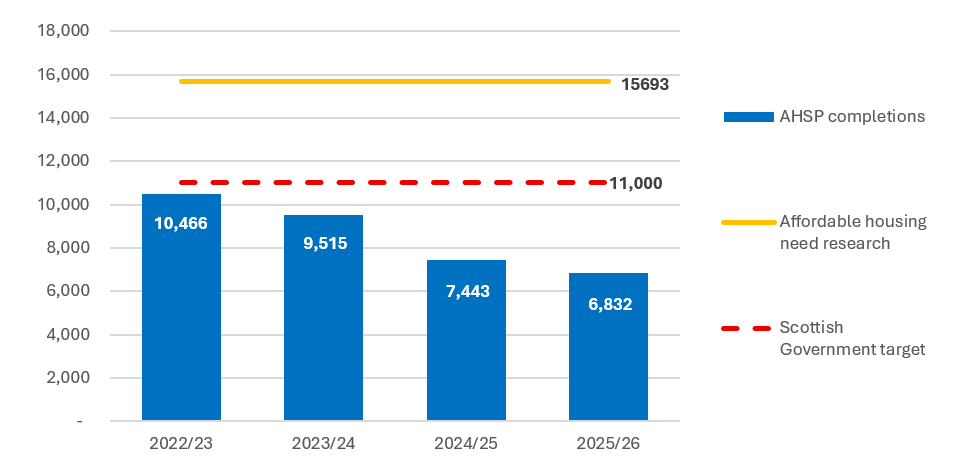
Affordable housing supply is key to tackling homelessness and the Scottish government’s planned investment of £4.9 billion over four years (an average of £1.23 billion annually) to support delivery of 36,000 affordable homes, an average of 9,000 per year, falls short of identified need. The Scottish government’s own target of 110,000 social and affordable homes over ten years would average 11,000 per year and independent research commissioned by CIH Scotland, Shelter Scotland and SFHA found that 15,697 homes must be delivered each year to meet needs.
The chart below shows the number of social and affordable homes completed through the Scottish government’s Affordable Housing Supply Programme (AHSP) up to 2025/26 (the latest data available) compared to the average of 11,000 completions per year required to meet the Scottish government’s own target and the 15,697 homes required to meet the need identified by our affordable housing research.
Chart 1: Number of AHSP completions compared to Scottish government supply target and affordable housing need identified by CIH, Shelter and SFHA research
Source: Affordable Housing Supply Programme summary tables financial year completions, Scottish government affordable housing supply target, Affordable Housing Need in Scotland Post 2026
Independent living
Scotland’s population is ageing at a faster rate than the rest of the UK and people are living in poor health for longer. National Records of Scotland population statistics show a 47% increase in the number of people aged 75 and over since 2004 and project that this group will increase by a further 341,000 people by 2047.
An ageing population is a testament to advances in healthcare and living conditions but does come with challenges including increased likelihood of health conditions and the need for greater support for people to live well in our communities, avoiding unplanned hospital admission and costly residential care.
Research on the future demand for adaptations commissioned by CIH Scotland, SFHA and ALACHO found:
- Increasing costs to install adaptations
- A reduction in the number of installations post COVID-19 despite evidence of increased need
- A complex system of different funding streams across tenures and approaches across different local authorities making adaptations more difficult to access.
The research suggests that meeting the need for adaptations could increase from £68 million per year in 2025 to £76 million by 2040 (not taking inflation into account). If the Scottish government does not fund this shortfall, more people will be living without the adaptations they need increasing the risk of an accident, potential for hospital admission and/or the need for costly residential care.
The University of Stirling is carrying out further analysis on the costs vs benefits of adaptations to inform the Scottish government’s current review of the adaptations system.
Meeting changing needs and supporting our housing workforce
Our members, who work in a wide variety of roles across the housing sector, have told us that social housing staff are dealing with increasingly complex cases involving people with multiple needs which are sometimes not being met by health and social care colleagues, potentially due to budgetary pressures elsewhere.
Research on Leadership and Culture in the Scottish Social Housing Sector we published earlier this year highlighted concerns from front-facing housing staff and senior leaders. The most common were:
- Being able to invest in social housing (84%)
- Meeting critical housing need including homelessness (84%)
- Maintaining the quality of housing stock (77%)
Respondents also mentioned challenges with workforce burnout, staff shortages, recruitment and retention issues, and rising financial and regulatory pressures.
There is a clear need for more focus on workforce development to ensure that the sector has the skills and resilience needed to meet future challenges. We also think that greater emphasis on prevention and better partnership working will help to avoid more people reaching housing crisis and requiring more intensive interventions.
The Scottish government’s focus on investing in social and affordable housing is welcome, but as we outlined above, planned investment will fall far short of need.
The new homelessness prevention duties included in the Housing (Scotland) Act 2025 have the potential to transform our approach to homelessness and create opportunities for interventions much earlier which could prevent people from reaching a crisis point and potential homelessness. However, the success of the legislation is highly dependent on resources being made available to support implementation alongside existing services. This will require additional funding in the short to medium term but will deliver long-term savings if successful.
The Scottish government’s ten-year £50 million homelessness prevention fund is welcome, but services need long-term financial certainty to be able to plan and commission provision, recruit and retain staff. The £4 million “ask and act” pilot projects will provide vital learning to underpin the development of the prevention duty. But beyond the pilot projects, Scottish government must provide long-term multi-year funding to embed the changes.
Working as it should, ask and act will foster up-stream prevention work, providing support where it’s needed and stopping people from reaching a crisis point. Without proper resources for developing and embedding new processes, ask and act risks becoming a referral programme into already stretched homelessness services.
Efficiency requires better partnership working and prevention but there are a number of barriers. There are of course financial barriers which can result in reluctance to take risks or to share budgets across departments or between organisations. Culture and organisational barriers can also stifle partnerships with people working to different priorities rather than realising the benefits of shared outcomes.
Our work on Rapid Rehousing Transition Plans (RRTPs) found that there were many examples of good partnership working on homelessness prevention at a local level, but these very much depended on relationships, developing organically rather than being driven strategically. Local authorities that took part in the work suggested several changes that could help support partnership working:
- Raising the profile of RRTP work and the cross-sector benefits
- Co-location of services
- Job shadowing to build understanding and knowledge
- Involving people with lived experience of homelessness in service design
- Removing barriers to joint commissioning
- Stronger leadership and messaging from Scottish government
- Better communication and joined up working with the third sector to avoid duplication and make the most of available funding.
For more information on our response please email scotland@cih.org.