

30 Jun 2026
The state of homelessness in Wales
The UK Housing Review 2026 has highlighted an increasing rate of core homelessness in Wales for another year. This growing rate of families and individuals living in unsuitable accommodation is just one of the concerns when it comes to homelessness and housing in Wales.
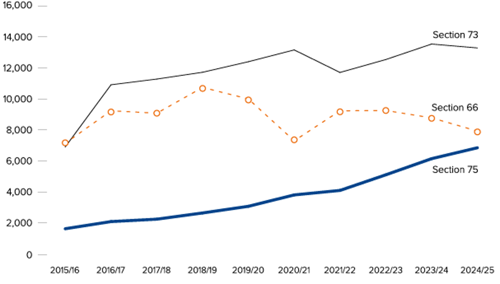
According to the latest Wales Housing Monitor, the number of households owed a full homelessness duty in Wales has been increasing year on year since April 2015. This is despite a key aim of the Part 2 Housing (Wales) Act 2014 being to ensure that local authorities had to intervene to prevent (Section 66) and to relieve (Section 73) homelessness to reduce the number of households owed the full duty (Section 75).
Yet the data does not reflect these aims. Since April 2015 there has been a 324 per cent increase in the number of households owed a full homelessness duty in Wales (from 1,611 to 6,840). Over the same period the number of households owed a prevention duty has been largely decreasing.
Households threatened with homelessness (Section 66) owed a relief duty (Section 73) or owed a full homelessness duty (Section 75)
What is core homelessness?
Core homelessness includes households sleeping rough, individuals in unconventional places not meant for residential use and those living in temporary accommodation. It draws on numerous data sources meaning that measures of core homelessness are less dependent on policy and legal arrangements. As a result, it provides a robust basis for comparisons across Great Britain.
Until 2018 Wales had the lowest level of core homelessness in the UK. However, by 2026 the rate of core homelessness was 0.92%, in England it is 1.2% and Scotland 0.62%. All three countries have seen a rise in core homelessness but the increase in Wales has been longer and more sustained.
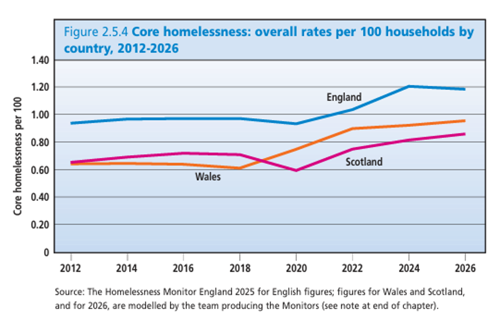
You can explore the full data behind this in the UK Housing Review compendium of tables.
Why do local authorities need to use temporary accommodation?
At the start of the COVID-19 pandemic in March 2020 the Welsh government applied a no one left out approach to ensure anyone rough sleeping or at risk of rough sleeping could be provided with temporary accommodation to keep them safe from the risk of disease. On October 24, 2022, legislation was introduced to ensure that this approach was made permanent in Wales. Local authorities in Wales now have a duty to provide these individuals with temporary accommodation and secure a long term home.
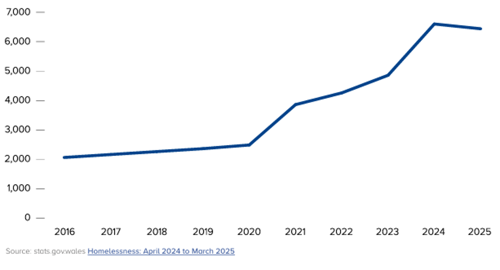
Post COVID-19 and the change in legislation there has been a significant increase in the number of households supported in temporary accommodation.
Number of households in temporary accommodation as of 31 March annually
Why do we need more housing in Wales?
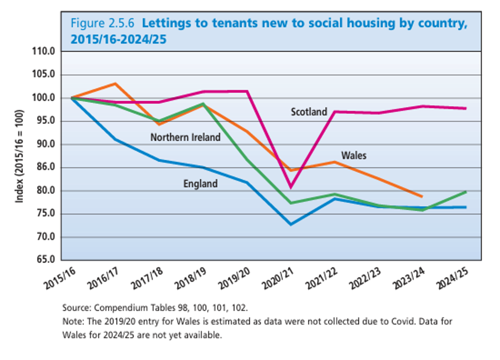
Homelessness can ultimately only be solved through the provision of a home or by preventing homelessness from happening in the first place. Yet the annual flow of lettings made by social landlords over the last decade has reduced significantly. This is driven by a slower rate of turn over and insufficient new supply.
 Research by Shelter Cymru published in 2025 and based on a summer 2024 freedom of information request, showed that there are 94,000 households waiting for a social home in Wales. This is one in every 14 households. Utilising Census data, the report estimates that this is equivalent to 168,000 to 177,000 people, including between 47,000 and 55,000 children. The report goes on to state that at current delivery rates it could take more than 30 years to provide every household with the home they need.
Why is Welsh government bringing in new legislation to focus more on prevention?
Welsh government introduced a white paper in June 2025 to look at a new homelessness system in Wales to focus on earlier identification and prevention of homelessness. It also proposed a multi-agency response to homelessness.
The Homelessness and Social Housing Allocations (Wales) Act received Royal Assent on 1 April 2026. The act has a greater focus on prevention with a prevention duty being triggered where there is reason to believe a person is threatened with homelessness within six months - an extension from the 56 days currently in place. This threatened with homelessness period also provides greater alignment with the Renting Homes (Wales) Act 2016 with its six month minimum notice period for a no fault eviction.
To further strengthen the work to prevent homelessness in Wales the act also creates a new ask and act duty for a wide range of public bodies and introduces mandatory prevention support and accommodation plans co-produced with applicants. The act abolishes priority need and intentionality to provide a more trauma informed person centred approach to homelessness legislation in Wales.
Is new legislation the only solution?
Our members don’t think that legislation is the only solution. They feel that in order to effectively tackle homelessness we also need an adequate supply of social and affordable homes. The data also shows us this reduced lettings and increasing demand for homes with increased unaffordability in the private sector is the perfect storm raising levels of homelessness across Wales and the wider UK.
If you want the full analysis, data and charts behind these findings, download the UK Housing Review 2026 for free today and explore the chapter on help with housing costs. It is essential reading for anyone working to make renting genuinely affordable.