


Scotland Housing Awards 2026
Read all the shortlisted entries into this award category, Excellence in Health and Wellbeing, at the Scotland Housing Awards (SHA) 2026 and find out who won the award on the night.
The right to an adequate standard of housing is inextricably linked to the right to the highest attainable standard of health. The right to health is a shared and inclusive right and good quality, sustainable housing is key to fulfilling this for individuals, families and communities.
Winning project name
Home, Health & Hope - Transforming Lives Through Tenancy Sustainment
Winning organisation
Horizon Housing Association
Statement of support
Main summary
At Horizon Housing Association, tenancy sustainment is not simply about preventing rent arrears or resolving benefit issues. It is about the point where good housing, financial security, health and wellbeing meet. As a specialist provider of accessible housing, many of our tenants live with disabilities, long-term health conditions and complex support needs. For them, the right support at the right time can be the difference between crisis and stability, isolation and connection, or anxiety and independence.
Horizon’s free, confidential and person-centred tenancy sustainment team has operated since 2013 with just two part-time colleagues. In 2025/26, it received 305 referrals and secured £1,367,442.86 for tenants through welfare rights advice, income maximisation, benefit claims, grants and targeted support. More importantly, this helped people remain safely housed, manage financial pressures and improve their quality of life.
Support that changes lives
The team's approach is holistic. Alongside welfare rights and income maximisation, colleagues connect tenants with social work, occupational therapy, energy advice, money advice, mental health support and community services. Every intervention is tailored to the individual, recognising that stable housing, appropriate support and financial security are fundamental to health and wellbeing.
One tenant moved from accommodation that was completely unsuitable for their physical health needs into a Horizon home designed to better meet their requirements. Living with both physical and mental health challenges, they were anxious about moving and establishing a new tenancy. The team secured essential household items through the Scottish Welfare Fund, ensured benefit entitlements were correctly established, arranged a Council Tax exemption and referred the tenant to Link Living's Better Resilience Service to support their mental wellbeing. As a result, the tenant successfully established their tenancy and accessed ongoing support to improve their quality of life.
Preventing crisis through early intervention
The team also supported tenants through one of the most significant welfare reforms in recent years: the managed migration from legacy benefits to Universal Credit. Between April 2025 and January 2026, they supported 92 tenants through the transition, many with significant health conditions and disabilities. The process was often complex, involving errors in benefit awards, missing transitional protection payments and incorrect deductions that left some tenants hundreds of pounds per month worse off. Through direct advice, case escalation and expert advocacy, the team prevented significant financial hardship that would otherwise have affected tenants' health, wellbeing and housing security.
Securing independence and fairness
After a life-changing limb amputation left one tenant unable to return home, they moved into a wheelchair-accessible Horizon bungalow. The team coordinated benefit changes, supported the move and overturned an incorrect disability benefits decision at tribunal, securing more than £3,600 in backdated benefit and an ongoing £158 monthly increase. The tenant said they would otherwise have abandoned the appeal.
The team also supported a military veteran moving from homelessness into a permanent Horizon tenancy. Working with partners, they secured funding for furnishings, white goods, flooring, rent in advance and welfare support. Recognising the risk of social isolation, the team arranged befriending support and connected the tenant with local community groups. The tenant has since moved into full-time employment and is sustaining their tenancy independently.
Delivering health, wellbeing and housing outcomes
This work delivers Horizon’s Business Plan commitment to independent living and sustained tenancies while advancing prevention, accessibility, financial inclusion, health and wellbeing. By tackling the root causes of hardship early, the team helps prevent tenancy failure, homelessness and social isolation.
Through housing support, financial inclusion and partnership working, this two-person team delivers impact far beyond traditional tenancy management: income secured, homes protected, lives stabilised and confidence restored.
Outcomes and achievements
The impact of Horizon's tenancy sustainment team during 2025/26 has been significant, measurable and life-changing.
- Referrals and financial gains: 305 referrals received and £1,367,442.86 secured in financial gains for tenants.
- Housing costs and welfare support: £924,328.55 related to Universal Credit, Housing Benefit and Discretionary Housing Payments, directly helping tenants meet household costs and sustain their tenancies.
- Disability-related benefits: £139,403.66 secured through Attendance Allowance, Adult Disability Payment, Child Disability Payment and Disability Living Allowance, supporting disabled tenants to maintain independence and improve quality of life.
- Universal Credit migration: 92 tenants supported through managed migration from legacy benefits to Universal Credit between April 2025 and January 2026.
- Successful tenancy outcomes: 88% new tenancy sustainment and overall tenancy sustainment of more than 93%.
- Customer feedback: 95% felt their issues were addressed very or extremely well; 98% felt more able to sustain their tenancy; 100% would recommend the service to others.
- Personal impact: Support included helping tenants move into suitable accessible housing, challenge incorrect benefit decisions, avoid financial hardship, reduce social isolation and move from homelessness into sustained independent living.
By improving housing suitability, reducing financial hardship and supporting independent living, Horizon's tenancy sustainment team has delivered exceptional health and wellbeing outcomes for some of Scotland's most vulnerable households.
Shortlisted entries
Queens Cross Housing Association - QCHA Family Wellbeing Project
Application entry
- Project name: QCHA Family Wellbeing Project
- Lead organisation: Queens Cross Housing Association
Statement of support
Our Family Wellbeing Project is a community-based solution to help families in our area. We use our local connection to deliver small but significant interventions that make the difference to the health and wellbeing of families. Many of the families are not known to other services.
The project started six years ago as a test and learn pilot funded by SFHA Homelessness Prevention Fund and Nationwide Community grant. It is now core funded and we are in the process of expanding it.
The overarching objective of the project is to challenge the dynamics of child poverty and give children the best start in life. We know in our area that child poverty is an issue, e.g. in the Woodside area 15.8 children per 100 are living in deep poverty and 31.3 children per 100 are living in relative poverty.
We aim to achieve this objective by using a holistic approach to support families to create an environment where their children can thrive. The project works primarily with lone parents, young parents and working parents who live in our tenancies. Families are provided with one-to-one support from our family wellbeing community connector. This support is provided face-to-face at a time and place that suits them. Support is provided to families to manage their homes, improve their financial wellbeing, improve health, enable parents to build positive relationships with others, connect to the local community and access personal development opportunities. This is often not straightforward due to the barriers that families face.
To complement the support that we provide families, we have funds for families to improve digital inclusion, furnish their home and respond to hardship. These funds enable us to help families in a quick and dignified way.
Examples of what interventions look like in practice are:
- Supporting families to furnish and decorate their homes. As well as supporting with the basic items that a family needs, there is a focus on supporting families to personalise their home. In addition, we like to support the parent to set up and personalise their children’s bedroom
- Supporting families to maximise their income by applying for benefits they are entitled to, reducing outgoings, ensuring bill payments are affordable and setting up bank accounts
- Supporting families to attend local activities and events to reduce isolation and build a connection to the local community
- Accessing funding to provide children with opportunities that other children take for granted, e.g. getting their first bike, art and drawing equipment, a desk to do their homework and clothing for outdoor play
- Supporting families to overcome barriers in accessing training, education and employment, e.g. accessing childcare, building confidence, numeracy and literacy skills
- Encouraging parents to link in with health professionals and offering support to attend appointments, as many parents do not prioritise their own wellbeing
What makes the Family Wellbeing project different is a:
- Focus on early intervention. All families who move into a QCHA tenancy are contacted by the Family Wellbeing project and offered support to settle into their new home
- Focus on relationship building with families. Understanding families may be reluctant to engage with professionals, taking the time to get to know a family and understand their needs
- Focus on evidence. The project's approach has been influenced by families who have lived and living experience of homelessness and poverty, information from our Getting to Know You tenant survey and statistics we know about the area that we are based in.
Outcomes and achievements
Our Family Wellbeing project has provided 160 families with one-to-one support.
The outcomes of support for families includes:
- Ninety per cent supported to create a suitable and safe home
- Seventy-two percent saw an increase in their income
- Fifty-five per cent supported to significantly reduce their debts
- Sixty-five per cent supported to link in with health services
- Seventy-three per cent identified an improvement in their mental health
- Eighty per cent thought their parenting skills had improved
- Seventy per-cent felt better connected with local communities.
The impact is best described by someone who is supported by our Family Wellbeing community connector:
“I wouldn't be where I am just now. It has changed my life and has been the best thing that ever happened to me. She helped me get a move to my forever home. She helped me get my wee boy into nursery. She also helped me get a link worker at the doctors. My whole life has changed. I really struggled with my mental health and my confidence and since she worked with me everything has changed. I really enjoy her visits and chatting to her and I tell her about things I'd done and she makes me feel proud of myself.”
Harbour Homes - Tenant Advice Service
Application entry
- Project name: Tenant Advice Service
- Lead organisation: Harbour Homes
Statement of support
Background
Harbour Homes is Leith’s biggest registered social landlord, managing over 3,000 tenancies in North Edinburgh. Harbour Homes has a Tenant Advice Service which uses early intervention to help improve living conditions for tenants who may be facing difficulty at home. In 2025/26 the team of tenancy sustainment officers, welfare rights officers, energy advice officers and a money advice officer helped 198 tenants to improve their living conditions and household costs.
Improving living conditions and housing suitability
Harbour Homes has identified different challenges faced by both new and existing tenants in turning an empty social rent property into a comfortable home with good living conditions.
For new tenants, particularly those coming from a homeless background, the offer of a suitable home is only the first step. The cost of carpeting and furnishing an empty home can be a barrier, particularly to those on low incomes. For some tenants who have no prior experience managing a home, or where previous tenancies have failed, this challenge is even greater. At the outset of a tenancy, Harbour Homes’ tenancy sustainment officers will source grants to ensure the home is appropriately furnished.
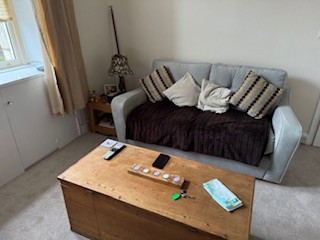
For existing tenants, further support may be required to ensure they can manage the upkeep of their home both practically and financially. Intervention from Harbour Homes has helped tenants who have struggled to replace higher cost items such as white goods or furniture to improve their living conditions. There are also issues which may present themselves to front line staff such as tenants struggling with health issues, both mental and physical, that can decrease living conditions or indicate that the home is no longer suitable for them.
Improving household costs
Early intervention by the Tenant Advice Service helps frontline staff determine whether a tenancy is likely to be sustained. Where issues are identified, further support may be required to ensure tenants can manage the costs associated with the tenancy and the upkeep of their home.
To address this, Harbour Homes provides welfare rights advice and money advice to tenants. This means that tenants can be assisted to maximise their income and ensure appropriate benefits are in place. A recent example was a tenant who was found to be struggling on a low income of just £72 per week. The Tenant Advice Service helped to secure a financial grant to pay off their overdraft for immediate relief. They then referred them to Harbour Homes’ employability service who assisted the tenant in taking steps to return to paid work.
Other tenants struggle to keep their home warm due to high energy costs. The Tenant Advice Service has assisted tenants with emergency top-up vouchers and energy advice. Earlier this year, the service helped a tenant who was without heating and hot water for almost three weeks. They did not know who their energy supplier was and had unknowingly not been paying for gas, nor did they have a working gas meter. An energy advice officer led the complex investigation into the issue, and a new meter was fitted. Gas safety checks were arranged, and a grant was secured to replace the tenant’s broken fridge freezer which was spotted during the investigation.
Improving housing satisfaction
Providing a holistic service improves outcomes for tenants and minimises stress that can be associated with having to engage with multiple agencies. The team actively encourages, where appropriate, cross-team referrals with other front-line staff at Harbour Homes to ensure that multiple issues can be addressed together. This includes working with Harbour Homes’ subsidiary Harbour Multi-Trades to address practical concerns in the home and improve overall satisfaction.
Outcomes and achievements
Customer feedback
The service has received positive feedback. For 90% of respondents, the service received helped make a difference to their situation. For 100% of respondents, they were satisfied or very satisfied with the service they received. All respondents (100%) reported being kept informed throughout the process. Likewise, 100% of respondents felt the service was easy to access and would recommend it to others. This feedback is used to shape changes to the service and forms part of the annual service delivery plan.
The service received 198 individual referrals in 2025/26. A total of 93 grant applications were discussed with tenants, and 17 tenants were referred to further support. The team achieved financial gain back to service users of £427,960.
Lessons learnt
Offering a one-stop holistic service is beneficial to Harbour Homes tenants and can improve their living conditions and help them to manage household costs. This is evidenced by the significant amount of financial gain received by Harbour Homes tenants. Advisers find that the presenting issue is part of a larger, more complex series of difficulties experienced by tenants. Having the ability to combine financial and benefits advice alongside grants and practical support leads to better outcomes.
West Dunbartonshire Council - Willox Park
Application entry
- Project name: Willox Park
- Lead organisation: West Dunbartonshire Council
Statement of support
The redevelopment of Willox Park represents a transformational investment in the health and wellbeing of older residents by West Dunbartonshire Council. The former Willox Park sheltered housing complex was built in the 1960s and had served the community for decades, but had deteriorated significantly, resulting in living conditions that were no longer suitable for tenants with complex health and mobility needs. Extensive building surveys confirmed severe damp and mould, failing cavity insulation, poor ventilation, defective concrete beams, inadequate space standards and non compliance with modern fire and life safety regulations. These issues were directly contributing to poor health outcomes, exacerbating respiratory conditions, increasing anxiety, and undermining tenants’ overall wellbeing.
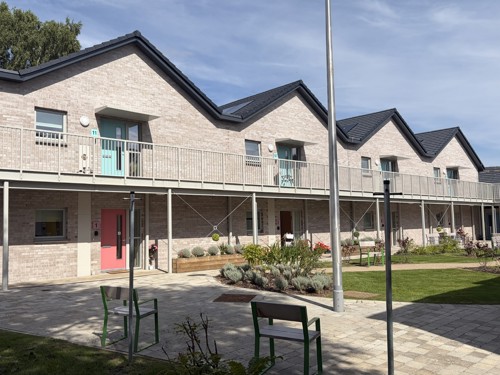
Recognising that the buildings were beyond repair, West Dunbartonshire Council committed to a full redevelopment of the site through a phased masterplan. The first phase delivered 17 new high quality homes designed specifically to meet the health, social and mobility needs of existing tenants. Throughout the design process, tenants were engaged regularly to ensure the new homes would support their independence, comfort and wellbeing.
Improving living conditions and delivering positive health outcomes were central to the design approach. Mechanical Ventilation with Heat Recovery (MVHR) systems were installed to provide continuous clean air, addressing the previous issues of damp, mould and poor ventilation. A fabric first approach, including super insulated roofs and walls and triple glazed windows, ensures warm, dry and energy efficient homes. Photvoltaic panels and the introduction of a ground source heat pump system which provides stable, efficient heating both contribute to the reduction of fuel poverty and support long term affordability.
The design also prioritised social wellbeing. The previous site layout was fragmented and difficult to navigate, contributing to isolation among residents with mobility challenges. The new development places all front doors around a shared landscaped courtyard with seating, encouraging incidental social interaction and creating a safe, welcoming environment that supports mental wellbeing. The common room and warden’s office are also located within the building, ensuring easy access to social activities, support services and community events.
All 17 homes meet the enhanced space standards for wheelchair users outlined in Housing for Varying Needs standards and also incorporate dementia informed design principles, including colour coded entrances, clear wayfinding and lift access. Homes were designed to be flexible and easily adaptable to changing mobility needs, supporting long term sustainable tenancies and enabling residents to live independently for longer.
It was essential to work with a contractor who recognised the complexities of delivering a new build development within an occupied, fully operational sheltered housing environment, and who could respond effectively to the concerns of residents living adjacent to the works site. McTaggart Construction established clear communication and considerate engagement with the community through regular newsletters and attendance at monthly tenants’ meetings. This ongoing relationship ensured that residents’ concerns were understood and addressed throughout the duration of the build.
Recognising the stress that relocation can cause for vulnerable tenants, the Council also provided full support with moving arrangements and costs, ensuring the transition was as smooth and anxiety free as possible.
The new Willox Park development demonstrates a clear commitment to improving living conditions, reducing household costs, and enhancing housing satisfaction. It delivers safe, warm, healthy homes that directly support improved physical and mental wellbeing, while creating a community environment that reduces isolation and strengthens social connections. This project embodies the ambitions of West Dunbartonshire to place residents' health, dignity and quality of life at the heart of housing design and delivery.
Outcomes and achievements
The new Willox Park has had a profound and measurable impact on tenants' health, wellbeing and quality of life. Residents report feeling significantly happier, safer and more comfortable in their new homes, with one tenant stating: “It’s a big difference being out of the old place. It’s a dream come true.”
Improved living conditions have also led to clear health benefits. The MVHR system has dramatically improved air quality, with one tenant reporting a major reduction in asthma symptoms, now requiring an inhaler only once per day instead of four.
These warm, well insulated homes with efficient heating system have provided an A energy rating and reduced average energy bills by 35%, easing financial pressure and supporting long term affordability.
Housing satisfaction has increased substantially. The shared courtyard has become a focal point for everyday social interaction, helping to reduce isolation and strengthen community bonds. Tenants regularly sit outside to enjoy the sun and chat with neighbours, with one resident noting: “We like to sit and have a wee blether.”
Overall, the development has achieved its ambition of delivering healthy, sustainable homes that improve physical health, reduce household costs and enhance social wellbeing, demonstrating excellence in health-focused housing design.