


Welsh Housing Awards 2026
Read all the shortlisted entries into this award category, Excellence in Preventing Homelessness, at the Welsh Housing Awards (WHA) 2026 and find out who won the award on the night.
This award celebrates organisations, individuals or projects that have worked towards preventing or relieving homelessness in the communities they work in.
Winning project name
Support at Cardiff Young Persons' Schemes
Winning organisation
Hafod
Partner organisation
Llamau
Statement of support
At Hafod’s young persons’ schemes in Cardiff, our colleagues provide housing related support to nine young people.
The team are committed to helping prevent homelessness by creating not just somewhere for the young people to live, but a place to belong with support that meets their individual needs.
For a young person who has experienced homelessness or who has spent their younger years in the care system, living at a supported scheme can mean safety and stability, and the opportunity to imagine what the future could hold.
With support delivered by Hafod in partnership with Llamau, the schemes provide shared accommodation for young people aged 16–22. The housing related support provided by Hafod colleagues at the schemes provides a foundation from which young people can develop the skills and confidence needed to live independently.
Colleagues take a person-centred, trauma-informed approach that recognises every young person has their own experiences, strengths, talents and ambitions. Their role is to help them discover what they are capable of, or as Regional Support Manager Christine Crocker puts it, “find their superpowers”.
For some young people, this may be the first genuinely safe and secure home they have experienced. Colleagues create a welcoming environment through the things that can easily be taken for granted such as Wi-Fi to stay connected with friends, celebrating birthdays, sharing meals and taking time to build relationships. Christine describes it as the schemes aim to create a “natural cwtch” where young people feel at home.
Young people receive practical support with budgeting, finances, tenancy readiness, education and employment, while being encouraged to explore their interests and ambitions.
For 18-year-old Rhys, that meant discovering his voice and a talent for public speaking. With support from Hafod colleagues, Rhys enrolled on Llamau’s Education Programme, developing literacy and numeracy through practical activities. He then worked with Transport for Wales on workshops exploring Cardiff’s railways and was selected to write and deliver a bilingual speech at a major event at Cardiff Central station. Rhys stood in front of a large audience and delivered his speech, receiving the loudest applause of the event.

Like Rhys, J also received housing related support, and his story demonstrates how it has enabled him to maintain his own tenancy. When he started receiving support from Hafod, he had spent almost three years without a stable home, having moved between friends’ sofas, hotels and hostels. Initially reluctant to accept support, Jake gradually built a trusting relationship with the team. Together, they worked on his finances, opened a bank account and developed the practical skills needed for independent living.
Today, J has something he had been missing; “For the first time in years, I have somewhere that feels like home instead of somewhere I'm just staying.”
Critical to the success of this service is that our support does not end when a young person moves on. Where needed, the same colleagues can continue supporting them, providing vital continuity and helping prevent homelessness by ensuring they are able to apply the skills they learned living at one of the support schemes. Crucially, young people do not have to repeatedly tell their story to new people, reducing the risk of re-traumatisation and preserving relationships built on trust.
By combining housing related support with trusted relationships, partnership working, practical skills, education, employment opportunities and genuine investment in each young person’s potential, Hafod’s housing related support teams in Cardiff are helping young people to create futures where they are able to manage their own home, reducing the risk of homelessness.
Outcomes and achievements
For Hafod’s housing related support team in Cardiff, the outcomes for the young people they support are deliberately individual. For one young person, success may be sustaining a tenancy, for another, it may be returning to education or discovering a new talent.
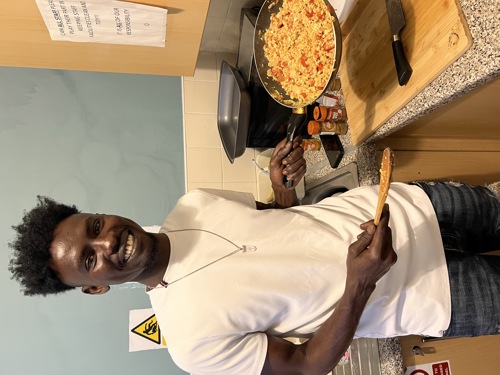
One cooking skills session saw Moner prepare a traditional Sudanese dish, tawa, alongside homemade vegan bread, he even shared his recipe with Hafod customers through the Connect newsletter.
Through continuity of support when young people move on, the the risk of homelessness returning is reduced. Of the support he receives, J has shared;
“The fact that I have support for a further 15 months has made me far more confident than I originally was.
“I know how to budget… I even learnt how to cook, which seemed impossible at the start. I thought I would be living on meal deals for the rest of my life!"
“My biggest goal now is to keep moving forwards. I want to maintain my tenancy… I know life will still have challenges, but now I believe I have the confidence and skills to deal with them."
And finally, J said, “For the first time, I'm genuinely excited about what comes next.”
Shortlisted entries
Tai Tarian - Enhanced Housing Team - One year in
Application entry
- Project name: Enhanced Housing Team - One year in
- Lead organisation: Tai Tarian
Statement of support
Tai Tarian has developed an innovative, sustainable and genuinely person-centred approach to tenancy sustainment, demonstrating how housing organisations can use resources differently to prevent crisis, improve wellbeing and help people remain safely in their homes.
Working with the local authority and a specialist advisor, we developed a service model enabling us to claim enhanced housing benefit for up to 150 dispersed supported units across the borough. This has created a sustainable funding stream, bringing additional UK government funding into the local area and enabling us to invest in enhanced housing management and support without relying on already fully committed Supporting People funding.
The innovation is not simply in the funding mechanism, but in how that funding has been used. Rather than adding another layer of reactive housing management, we have created the capacity for proactive, relationship-based support focused on tenancy sustainability, wellbeing and independence.
A defining feature is our low caseload model. Enhanced housing officers work with approximately 40 tenants each, giving them the time to understand individual circumstances, build relationships and identify concerns before they escalate. Officers can visit when needed, coordinate support, connect tenants with specialist services and remain alongside them as they work towards positive change.
A powerful example is an anonymised tenant who had experienced longstanding difficulties, including hoarding behaviours and significant deterioration in the condition of their home. Previous enforcement-led interventions had resulted in the property being cleared, but the situation quickly deteriorated again. Referrals to external services had also been unsuccessful because the tenant was unable to engage.
Our approach was different. Rather than focusing solely on the condition of the property, the support assistant invested time in building trust and understanding the person behind the tenancy. Over many months, conversations focused on wellbeing, with no pressure to make immediate changes.
The turning point came when the tenant asked for help themselves. This changed the nature of the intervention from something being done to the tenant to something being achieved with them. Working alongside the support team, the tenant reduced the clutter in their home and, with support from our Solutions Fund, a deep clean was completed. Crucially, the tenant also engaged with Mind for mental health support, beginning to address some of the underlying issues contributing to the situation.
The tenant described the support as “brilliant” and said it had “changed my life.”
This case demonstrates why time and relationships matter. The outcome was not achieved through a single intervention; it was achieved because an officer had the time to build trust and wait until the tenant was ready and then support available to them to lead the change themselves.
The impact extends beyond individual case studies. In its first year, more than 170 tenants have been supported to sustain their tenancies and improve their wellbeing. We have seen safer homes, improved wellbeing, greater independence and stronger connections with specialist services.
Tenants told us:
- “They have been brilliant with me, really understanding and supportive.”
and:
- “We never felt judged.”
These comments capture the essence of the service. Successful tenancy sustainment is not simply about managing a tenancy; it is about understanding the person, building trust and providing the right support at the right time preventing homelessness.
By combining a sustainable funding model, low caseloads, early intervention and person-centred practice, Tai Tarian has created a service that delivers both financial sustainability and meaningful social impact. Most importantly, it is helping people make changes that they are ready to own and sustain.
Outcomes and achievements
- Low caseloads of approx. 40 tenants per officer; enabling proactive, consistent and relationship-based intervention.
- Supported over 170 tenants to sustain their tenancies and improve their wellbeing.
- Earlier intervention, helping prevent issues escalating into tenancy breakdown and homelessness.
- Safer homes through practical interventions and support to address risks to health and wellbeing.
- Improved wellbeing and greater independence through personalised support and connections to specialist services.
- Stronger partnership working; successful engagement with external organisations and specialist support providers.
- A sustainable funding model using enhanced housing benefit to bring additional funding into the local area.
- In the last quarter alone 13 tenants moved off the service to live independently, these tenants were at risk of homelessness before engaging with us.
Most importantly, tenants are telling us how we provide support matters.
- “Really understanding and supportive.”
- “We never felt judged.”
- “Made us realise we need to make a change for ourselves.”
These words demonstrate the value of investing in relationships, time and personalised support.
The combination of innovative funding, flipping homes from support to GN's, low caseloads and a genuinely person-centred approach is helping us prevent tenancy breakdown, improve wellbeing and enable tenants to live safely and independently in their homes.
Holistic Hoarding CIC - Holistic Hoarding
Application entry
- Project name: Holistic Hoarding
- Lead organisation: Holistic Hoarding CIC
- Partner organisation: Caerphilly Council
Statement of support
Holistic Hoarding works across Gwent to prevent eviction for the growing numbers of people at risk of losing their homes due to hoarding. For Holistic Hoarding CIC and Caerphilly County Borough Council, homelessness prevention starts long before someone loses their home. Behind their front door may be a person overwhelmed by possessions they cannot discard; rooms becoming inaccessible; increasing fire or environmental risks; complaints from neighbours; safeguarding concerns; strained relationships with professionals and, eventually, the possibility of enforcement and eviction.
On paper, that person is still housed. Without the right intervention, however, the journey towards homelessness may already have begun.
The partnership between Caerphilly County Borough Council and Holistic Hoarding CIC was developed to interrupt that journey. Funded through the Welsh government's Housing Support Grant, the partnership recognises hoarding as a complex behaviour requiring more than a property-based response. Instead of asking simply, “How do we clear this home?”, the service asks, “What has happened to this person, what purpose are these possessions serving, and what support will enable them to remain safely in their home?”
That distinction has helped prevent 80 evictions in Caerphilly. Those are 80 households that did not reach the point of losing their homes; 80 occasions where specialist intervention offered an alternative to tenancy breakdown; and 80 examples of homelessness prevention taking place behind a front door, before homelessness needed to happen.
The impact extends beyond housing. Through this work, 35 children have been prevented from entering the care system, demonstrating how sustaining a home can help sustain a family.
The model combines specialist assessment, therapeutic relationship-building, regular home visits, harm reduction, motivational and behavioural-change work, practical support, multi-agency coordination and relapse-prevention planning. It recognises that simply removing possessions may change a property temporarily without addressing the reasons they accumulated. Sustainable homelessness prevention means working with the person, not doing something to them.
This approach requires patience. Progress may mean restoring a safe exit rather than emptying a room, or it may mean a person allowing a professional through their door after months of mistrust. It may mean reducing immediate fire risk while therapeutic work continues. These apparently small changes can be the steps that keep somebody safely housed.
The partnership also builds capacity around the individual. Holistic Hoarding works alongside housing, social care, fire and rescue, environmental health and other professionals, sharing specialist knowledge so risk can be managed collaboratively rather than allowing enforcement to become the default response.
This approach embodies the preventative purpose of the Housing Support Grant: intervening early, addressing the underlying causes of housing instability and helping people maintain safe, suitable homes.
Its impact can be counted in evictions prevented, risks reduced and children remaining with their families. But for our team, maybe the greatest achievement is perhaps what never happened. A possession order that was not required, or a family that was not displaced. A child who remained at home. A person who did not become homeless.
The success of this partnership is not measured by how many people it rehouses after crisis. It is measured by how many never need to be rehoused at all.
Thank you for taking the time to consider our application.
Outcomes and achievements
The partnership between Holistic Hoarding CIC and Caerphilly County Borough Council demonstrates measurable homelessness prevention through specialist, early intervention.
To date, the service has contributed to 80 evictions being prevented in Caerphilly, enabling people experiencing complex hoarding behaviours to remain in their homes rather than progressing into tenancy breakdown and homelessness.
The wider impact on families has been equally significant, with 35 children prevented from entering the care system through interventions that have helped create safer, more sustainable home environments.
Funded through the Welsh government's Housing Support Grant, the model combines therapeutic and practical intervention, harm reduction, specialist assessment, behavioural-change work, relapse prevention and multi-agency coordination. Rather than responding only when a property reaches crisis, support addresses the underlying behaviours and risks threatening the sustainability of the tenancy.
Outcomes include sustained tenancies, reduced eviction risk, improved home and fire safety, increased engagement with services, greater independence and reduced escalation into statutory intervention.
The partnership demonstrates homelessness prevention at its earliest and potentially most powerful point: while somebody still has their home. Its achievement is therefore not simply responding successfully to homelessness, but preventing people and families from experiencing it in the first place.