


Welsh Housing Awards 2026
Read all the shortlisted entries into this award category, Sustainability in Housing, at the Welsh Housing Awards (WHA) 2026 and find out who won the award on the night.
The housing sector, like many others, is faced with the challenge of making homes more efficient in order to tackle fuel poverty as well as cutting carbon emissions to achieve Welsh government’s net zero targets by 2050. This award recognises organisations that can demonstrate they have overcome some of the significant challenges in making our homes more efficient.
This award was sponsored by Menzies.
Winning project name
144 ultra-low-carbon homes at Gwyfaen
Winning organisation
JG Hale Group Ltd
Partner organisation
Codi Group
Statement of support
Gwynfaen is a pioneering, ultra-low-carbon development that redefines affordable and sustainable living in Wales. One of the first schemes to secure Welsh government's Innovative Housing Programme (IHP) funding, the development comprises 144 highly energy-efficient, off-gas homes designed to address the challenge of decarbonising housing while delivering lasting benefits for residents and the wider community.

Guided by the Well-being of Future Generations (Wales) Act, Gwynfaen was developed around three core principles: creating homes for life, tackling fuel poverty and fostering a thriving, sustainable community. Each home has been designed to Lifetime Homes, Welsh Development Quality Requirements (WDQR) and RNIB standards, ensuring properties can adapt to residents’ changing needs and support long-term independent living. By combining inclusivity with sustainability, the development provides futureproof homes that reduce the need for relocation while strengthening community resilience.
A fabric-first approach sits at the heart of the project. Homes have been constructed using locally manufactured timber-frame systems produced by SO Modular, incorporating Welsh timber, woodfibre insulation, high-performance thermal envelopes, exceptional airtightness and triple-glazed windows and doors. This approach delivers SAP ratings exceeding 96% and EPC A performance, significantly reducing operational carbon emissions and energy demand. By prioritising the performance of the building fabric before renewable technologies, Gwynfaen demonstrates best practice in sustainable housing delivery and provides a model for future low-carbon developments.
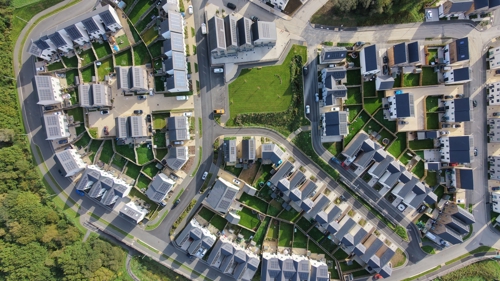
The project also helps drive the wider retrofit agenda by showcasing technologies and construction principles that can be applied across existing housing stock. Lessons learned from fabric-first design, improved airtightness, renewable energy generation and smart energy management systems provide valuable evidence for future retrofit programmes. Gwynfaen demonstrates how the integration of energy-efficiency measures and low-carbon technologies can lower carbon emissions, reduce energy consumption and improve resident comfort, supporting wider ambitions to decarbonise homes across Wales.
To combat fuel poverty and improve resident wellbeing, each home incorporates a suite of innovative technologies, including air source heat pumps, roof-integrated solar PV panels, battery storage, Mechanical Ventilation with Heat Recovery (MVHR), smart home energy applications and electric vehicle charging infrastructure. These systems enable residents to generate, store and manage their own energy while reducing reliance on fossil fuels. As a result, households benefit from lower energy costs, reduced exposure to rising energy prices and improved thermal comfort throughout the year.
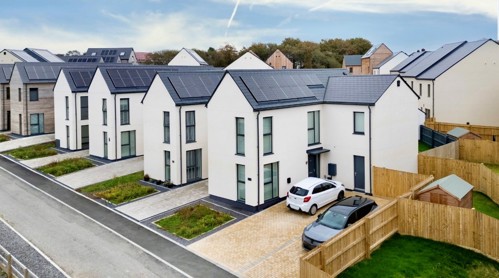
Resident health and wellbeing have been further enhanced through the specification of natural, low-VOC materials and breathable wall constructions. The use of timber, woodfibre insulation and healthy indoor finishes creates homes that regulate moisture effectively, reducing the risk of damp and mould while improving indoor air quality. Together, these measures support healthier living environments and improved quality of life.
Collaboration has been fundamental to the project’s success. Strong partnerships between Codi Group, JG Hale, SO Modular, the wider design team, local supply-chain partners and Welsh Government have enabled the delivery of a highly innovative development that challenges traditional approaches to affordable housing. By combining expertise in low-carbon design, modern methods of construction and community-focused development, the partnership has created a demonstrator project capable of influencing future housing and retrofit programmes throughout Wales.

Innovation extends beyond the homes themselves. Modern Methods of Construction enabled high levels of quality control, reduced waste, improved safety and accelerated programme delivery, with homes becoming watertight within days of installation. The project’s sustainability ambitions also extended to construction operations, including EV charging facilities, electric and hybrid company vehicles, journey monitoring, shared workforce transport and just-in-time delivery logistics, reducing transport-related emissions throughout the build.
Through innovative technology, sustainable partnerships and a commitment to resident wellbeing, Gwynfaen sets a new benchmark for affordable, low-carbon housing. The development demonstrates how sustainable design, renewable technologies and collaborative delivery can create healthier, more efficient homes while providing valuable learning that supports the future decarbonisation and retrofit of housing across Wales.
Outcomes and achievements
Gwynfaen has successfully delivered one of Wales’ most ambitious low-carbon housing developments, providing 144 fossil-fuel-free homes that combine affordability, sustainability and placemaking. The project has exceeded its core energy performance targets, with all homes achieving EPC A ratings and SAP scores between 96 and 104, significantly reducing operational energy demand and household running costs. Current evidence indicates resident energy bills can be as low as £33 per month.
The development has demonstrated how Modern Methods of Construction (MMC), fabric-first design and renewable technologies can be successfully integrated at scale. Homes utilise Welsh timber construction, air source heat pumps, solar PV panels, battery storage, MVHR and EV charging infrastructure, creating futureproof homes that address fuel poverty while improving resident comfort and wellbeing.
Gwynfaen has also delivered significant environmental benefits through reducing embodied carbon, including a reported 61% reduction through the adoption of timber construction and locally sourced materials. Waste reduction initiatives diverted 98% of construction waste from landfill, while offsite manufacturing, just-in-time logistics and low-carbon transport measures reduced emissions associated with construction activities.
Beyond environmental performance, Gwynfaen has created a thriving community centred around a village green, community hub and shared amenity spaces, providing a replicable model for sustainable housing delivery across Wales.
Shortlisted entries
Hafod - Powering a sustainable future
Application entry
- Project name: Powering a sustainable future
- Lead organisation: Hafod
Statement of support
Hafod is committed to creating more sustainable homes, reducing carbon emissions and supporting residents through the cost of living challenges associated with rising energy prices. Through an ambitious solar photovoltaic installation programme, Hafod has demonstrated how existing homes can be retrofitted at scale to support the Welsh government's net zero ambitions while delivering direct benefits to residents.
During 2024/25, Hafod installed solar photovoltaic systems on 496 homes. Building on this success, a further 460 homes received solar photovoltaic installations during 2025/26. Together, these 956 installations represent approximately 17% of Hafod's housing stock, making this one of the organisation's most significant sustainability initiatives to date.
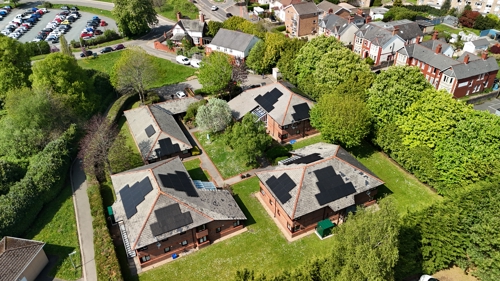
The programme forms a key part of Hafod's wider decarbonisation strategy and commitment to improving the energy performance of existing homes. Recognising that achieving net zero requires action now, Hafod has actively invested in retrofit measures that reduce reliance on grid electricity, lower carbon emissions and improve the long-term sustainability of its homes.
A major challenge facing the housing sector is balancing environmental objectives with affordability for residents. Hafod's solar programme directly addresses both challenges. By generating renewable electricity within the home, residents can reduce their household energy consumption and benefit from lower electricity bills. At a time when many households continue to face financial pressures, the installations provide a practical and lasting solution that helps improve affordability while supporting environmental goals.
The success of the programme has been driven by strong partnership working between Hafod, contractors, residents and funding partners. Resident engagement has been central throughout the delivery process. Hafod has worked closely with residents to explain the benefits of solar technology, support installation programmes and maximise resident understanding of how to make the most of the renewable energy generated within their homes.
Innovation has also played an important role in the programme. Hafod has embraced a data-led approach to decarbonisation, using property information, stock analysis and investment planning to identify homes most suitable for retrofit interventions. This strategic approach ensures that investment is targeted where it can deliver the greatest environmental and social impact.
The programme demonstrates Hafod's commitment to driving the retrofit agenda forward across Wales. While new homes are important, the greatest challenge lies in improving existing housing stock. By successfully delivering solar installations across 956 homes in just two years, Hafod has shown that large-scale retrofit programmes can be delivered effectively while maintaining a strong focus on resident outcomes.
Beyond carbon reduction, the initiative contributes to wider community benefits. Residents are supported to reduce energy costs, improve energy awareness and play an active role in the transition to a lower-carbon future. The project also provides a foundation for future renewable technologies and supports Hafod's longer-term ambition to create healthier, more efficient and more sustainable homes.
This programme exemplifies how housing associations can lead the transition towards net zero by combining environmental responsibility, resident support, innovation and partnership working. Hafod's solar installation programme is delivering measurable benefits for residents today while helping create a more sustainable housing sector for future generations.
Outcomes and achievements
- 496 solar photovoltaic systems installed during 2024/25.
- 460 additional solar photovoltaic systems installed during 2025/26.
- A total of 956 Hafod homes now benefit from renewable energy generation.
- Solar installations are now present in approximately 17% of Hafod's housing stock.
- Residents benefit from access to renewable electricity, helping to reduce household energy costs and improve affordability.
- The programme supports the reduction of carbon emissions across Hafod's existing housing stock.
- Significant progress has been made in driving the retrofit agenda forward through large-scale deployment of renewable energy technology.
- The project demonstrates how existing homes can contribute to Welsh government net zero ambitions through practical retrofit measures.
- Strong collaboration between Hafod, residents, contractors and programme partners ensured successful delivery at scale.
- The programme has increased energy efficiency across hundreds of homes while creating a platform for future decarbonisation initiatives.
- Residents have been actively engaged throughout the programme, ensuring they understand and maximise the benefits of their solar installations.
- The initiative is creating long-term environmental, social and financial benefits for residents and communities across Hafod's housing stock.
Trivallis - Asset Strategy and Sustainability at Trivallis
Application entry
- Project name: Asset Strategy and Sustainability at Trivallis
- Lead organisation: Trivallis
Statement of support
Actively responding to the challenge of making homes more sustainable:
Trivallis is taking a long-term, resident-focused approach to decarbonising homes through its Greener Futures Together sustainability plan and commitment to net zero by 2050. Recognising that its housing stock is its largest source of emissions, Trivallis is investing in warmer, healthier and more affordable homes while tackling the environmental challenges of existing properties.
Over the last year, 1,899 whole home assessments have been completed, with Target Energy Pathways developed for every property. These provide a practical, evidence-based route to improving energy efficiency and reducing carbon emissions, balancing cost, feasibility and resident needs.
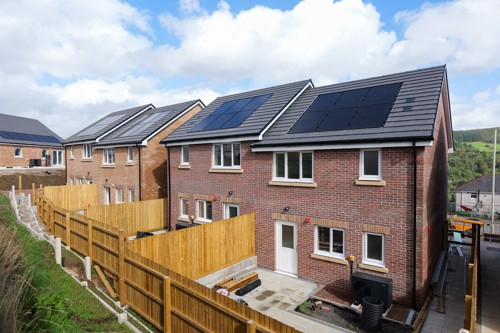
This approach is delivering measurable progress: Trivallis has achieved an average SAP score of 73, with approximately 80% of homes now meeting EPC band C or above.
The organisation is also embedding sustainability into new developments. Completed in 2025/26, Clos Yr Ysgol provides 27 affordable homes built to EPC A and B standards, giving residents access to highly energy-efficient homes and lower running costs from day one.
Maintaining its Silver SHIFT rating for the second consecutive year provides independent recognition of Trivallis’ sustainability performance, environmental leadership and responsible management.
Steps taken to drive the retrofit agenda forward:
Trivallis is accelerating retrofit by making energy efficiency and decarbonisation integral to its asset management and sustainability strategies.
Through the Welsh government-funded Optimised Retrofit Programme (ORP), the organisation has delivered tailored whole home improvements, including insulation, solar panels, roofing upgrades and intelligent energy systems. In 2025/26, 198 homes were upgraded through the Thermal Improvement Programme, helping residents achieve greater comfort and reduce energy costs.
Looking ahead, Trivallis has committed to further retrofit programmes based on PAS 2035 principles. Planned measures include air source heat pumps, solar PV, battery storage and ventilation improvements, creating a structured pathway towards lower-carbon homes.
Independent benchmarking through SHIFT Environment and the integration of climate resilience into long-term asset management ensure that investment delivers lasting environmental and social value.
Creating a positive impact on tenants and residents:
At the heart of Trivallis’ sustainability programme are the people who live in its homes.
Energy-efficient new builds and retrofit improvements can help residents reduce heating costs, address fuel poverty and enjoy more comfortable living environments. Better thermal performance can also support healthier homes by reducing the risk of damp and mould.
At Sŵn yr Afon sheltered scheme, solar installations are helping tenants lower energy bills while encouraging more sustainable behaviours. Resident experiences and case studies are shared to build confidence in retrofit and demonstrate the everyday benefits of energy efficiency.
Meanwhile, the new development at Clos y Ffatri in Porth is providing local people with affordable, modern homes designed to support lower running costs and improved quality of life.
Creating sustainable partnerships and collaboration and innovative use of technology:
Collaboration is enabling Trivallis to turn its sustainability ambitions into practical action. Partnerships with Welsh government, contractors, consultants, technology providers and residents are supporting innovation and investment across the supply chain.
During the year, 175 environmental sensors were installed in homes, capturing real-time data on temperature, humidity and air quality. This enables earlier identification of potential issues and helps residents understand and manage their home environment.
Trivallis is also building the skills needed to sustain progress. With 170 colleagues now Carbon Literate, the organisation has achieved Silver Carbon Literate Organisation status and is progressing a second phase of training to work towards gold.
Through targeted investment, strong partnerships and smart technology, Trivallis is making tangible progress towards net zero, delivering warmer, healthier and more affordable homes while supporting resilient communities across South East Wales.
Outcomes and achievements
Key project outcomes and achievements to date include:
Trivallis has developed and continues to deliver its Greener Futures Together strategy, providing a pragmatic roadmap to net zero by 2050 through targeted retrofit programmes and Target Energy Pathways for its housing stock.
Through the Welsh government-funded Optimised Retrofit Programme, Trivallis has upgraded 198 existing homes through its Thermal Improvement Programme. Data modelling shows that approximately 80% of existing homes now achieve EPC C or above.
The organisation has completed 1,899 whole home assessments, issued 1,823 EPCs and installed 175 environmental sensors to provide a practical, evidence-based route to improving energy efficiency and reducing carbon emissions.
Trivallis has also delivered 27 energy-efficient new social homes at Clos Yr Ysgol, rated EPC A and B.
Its sustainability achievements include maintaining a Silver SHIFT Environment rating for two consecutive years and achieving Silver Carbon Literate Organisation status after certifying 170 colleagues.
Trivallis - Reimagining Solar for Sheltered Housing – Swn yr Afon
Application entry
- Project name: Reimagining Solar for Sheltered Housing – Swn yr Afon
- Lead organisation: Trivallis
Statement of support
Swn yr Afon demonstrates how Trivallis has challenged the traditional approach to solar power on sheltered housing to ensure residents, rather than only the communal electricity supply, directly benefit from renewable energy generated on their building.
Previous solar installations on Trivallis sheltered schemes primarily supplied electricity to communal facilities and services. While reducing communal electricity consumption and carbon emissions, individual residents did not directly benefit from the electricity generated.
Trivallis wanted a better solution. At Swn yr Afon, a 60-kilowatt rooftop solar array connected to three Allume SolShare units now distributes renewable electricity across 34 individual flats, shifting the model from powering communal services to powering residents’ homes. The system was also designed with future decarbonisation in mind, including the potential transition from gas to communal heat pumps.
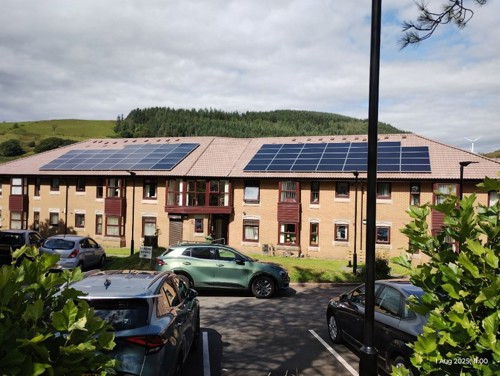
Adopting SolShare represented a bold step. The technology offered a solution to sharing rooftop solar between individual flats, but its eligibility for grant funding first had to be established. Trivallis helped bring Allume and Welsh government together, including discussions at the Housing Industry Leaders Conference in Cardiff, enabling the approach to progress through the Optimised Retrofit Programme.
Roof replacement was coordinated with the renewable energy installation, bringing planned asset investment and decarbonisation together.
Swn yr Afon is not a one-off project. Learning from the scheme will inform Trivallis's approach to its other sheltered housing complexes, creating the potential to replicate resident-focused shared solar where technically and financially appropriate.
The move to resident solar is already delivering measurable benefits:
- 34 flats directly benefit from locally generated renewable electricity.
- One resident reported electricity savings of £6 to £9 per month.
- Another reported that their typical electricity bill had almost halved.
- Residents are changing when they use appliances to maximise daytime solar generation.
- 65.37 tonnes of carbon dioxide emissions have been avoided since commissioning.
The benefits extend beyond energy. Engagement around solar brought residents together to understand the technology and discuss their community. A proportion of the contract was allocated to social benefits, with residents collectively deciding how it should be invested. They chose to transform an uneven, underused outdoor area into an accessible multifunctional space. The area was cleared, levelled and paved, and residents have since continued to develop it around their needs, creating a lasting community asset.
Swn yr Afon brought together Trivallis, residents, and project partners GB-Sol, Allume and Welsh government. Trivallis built on its previous experience with GB-Sol through the 66-home Brynheulog solar project and engaged directly with its technical director to understand manufacturing and discuss Trivallis's requirements. Panels were locally manufactured just 12 miles from Swn yr Afon, supporting local manufacturing and reducing transportation within the supply chain.
Collaboration between Trivallis, Allume and Welsh government was particularly important in overcoming the grant-funding barrier and enabling an innovative solution to proceed.
Allume SolShare overcame a fundamental limitation of conventional sheltered-housing solar: how electricity generated by one rooftop array could directly benefit residents living in individual flats.
The solution combines:
- A 60-kilowatt rooftop solar array.
- Three SolShare units serving 34 flats.
- Individual certification for residents' homes.
- Dynamic sharing of locally generated renewable electricity between individual properties.
By combining innovative technology with established technical expertise, Swn yr Afon provides a practical and potentially repeatable model for decarbonising sheltered housing while ensuring residents directly share in the benefits.
Outcomes and achievements
Swn yr Afon has transformed the traditional approach to solar power in sheltered housing from a communal energy resource into a resident-focused renewable energy solution delivering environmental, financial and social benefits to 34 sheltered housing residents.
Key achievements include:
- 60-kilowatts of rooftop solar distributed through three Allume SolShare units.
- Renewable electricity shared directly with 34 flats.
- 65.37 tonnes of carbon emissions avoided since commissioning.
- Residents reporting electricity bill savings, including one household whose bill has almost halved.
- Increased resident engagement with energy use, helping maximise the benefits of solar generation.
- A resident-led social benefit creating a new accessible outdoor community space.
- Learning that will inform the future decarbonisation of Trivallis’s remaining sheltered housing schemes.
Beyond the technology, the project has empowered residents to engage more actively with their energy use and demonstrated how shared solar can overcome a longstanding challenge enabling households in multi-occupancy buildings to benefit directly from renewable energy.
Wales & West Utilities - Cartrefi Hydrogen Homes
Application entry
- Project name: Cartrefi Hydrogen Homes
- Lead organisation: Wales & West Utilities
- Partner organisation: Codi Group
Statement of support
Cartrefi Hydrogen Homes is a pioneering partnership between Wales & West Utilities and Codi Group, created to explore how existing homes could be heated using hydrogen rather than methane (natural gas).
Over 80% of homes in the UK are connected to the gas network and are currently heated by burning methane (natural gas). Domestic heating accounts for around 20% of total carbon emissions in the UK. Adapting existing homes to be heated by low carbon energy solutions could reduce or remove these carbon emissions and have a significant impact on helping us to create more energy efficient, sustainable housing.
Delivered through a partnership between Wales & West Utilities, Codi Group, British Gas, Vaillant, Kiwa, IGEM and Steer Energy, and supported through the Welsh government's Optimised Retrofit Programme, the project transformed a traditional Welsh terraced property into a demonstration home.
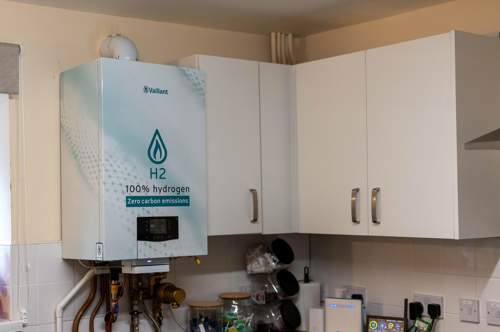
The two-bedroom, end of terrace property underwent a deep retrofit which included installing a hydrogen boiler and hob, and work to improve the house’s energy efficiency, creating Wales' first hydrogen home and the UK's first retrofit project of its kind.
Works at the site were carried out following HSE regulations and guidance, with minimal disruption to the local community and no change to their gas supply.
The project aims to demonstrate how many existing homes in the UK could easily switch from methane (natural gas) to green hydrogen as a viable alternative for quick, reliable and familiar heating and cooking.
By bringing hydrogen technology out of the laboratory and into a real-world setting, the project is generating invaluable data, critical evidence as well as opportunities for industry and supply chain learning. The demonstration home also enables the partners to engage with both the general public and customers allowing them to interact with the technology and demystify what home decarbonisation using hydrogen could look like in the future.
Matt Hindle, Head of Net Zero & Sustainability at Wales & West Utilities said:
- “Gas is a critical part of our energy system- and will be for decades to come, – heating homes, supplying industry and backing up renewable power generation. We are committed to working with partner organisations such as Codi to explore innovative, low carbon alternatives to help meet our customers’ environmental ambitions while providing world class resilience and minimising disruption. Cartrefi Hydrogen Homes shows what hydrogen looks like in practice, and we are delighted to welcome visitors who want to see the installation and learn more. As the build itself is a UK first, we’ve taken away lots of learning to share with the wider industry. We’ve applied outputs from previous projects and are updating processes and policies to be ready for hydrogen use across different sectors in the future.”
Nick Abbott, Sustainability Lead at Codi Group said:
- “As a Welsh not-for-profit, we work alongside people and communities to build and create homes that support better futures. Cartrefi Hydrogen Homes shows what’s possible when deep retrofit and emerging low-carbon technologies are brought together in a real home. Working in partnership with Wales & West Utilities, we’ve been able to demonstrate how improving the fabric of a traditional property first creates the right foundation for innovative solutions like hydrogen heating and cooking to be explored safely and effectively. This project has been a genuine ‘test and learn’ opportunity for everyone involved, and we’re proud to have helped deliver a UK-first retrofit that not only improves energy efficiency but also gives the sector practical insight into how homes of the future could be heated as we decarbonise.”
Outcomes and achievements
Since its launch, the project has received overwhelming support and interest from the local community, who have embraced Cartrefi Hydrogen Homes as an opportunity for their local area to play a part in exploring the future of decarbonising home heating.
To date, the project team has hosted over 350 visitors at the house, ranging from local residents, business owners, colleagues and social housing tenants as well as partners working within the energy, utilities and housing sectors.
In additional, the team has hosted local politicians, with a view of further promoting and highlight the sustainable housing and net zero agenda with key policy makers.
As well as attracting local interest, the project has attracted visitors from as far afield as Scotland, Northern Ireland and England.
Feedback from external visitors has been overwhelmingly positive, with an average project rating of 4.9 out of 5 and more than 95% believing that hydrogen could be used for heating and cooking in homes.
Our internal visitors have shared a similarly positive view, awarding the project an average score of 4.9 out of 5, while 93% believe hydrogen could play a role in domestic heating and cooking.
We hope to welcome many more.
ClwydAlyn and Cartrefi Conwy - Onnen: Driving Sustainable Homes Through Partnership, Innovation and Retrofit Excellence
Application entry
- Project name: Onnen: Driving Sustainable Homes Through Partnership, Innovation and Retrofit Excellence
- Lead organisation: ClwydAlyn and Cartrefi Conwy
Statement of support
Onnen was established in 2023 as a joint venture between Cartrefi Conwy and ClwydAlyn to address one of the biggest challenges facing the housing sector: how to decarbonise existing homes while ensuring tenants benefit from warmer, healthier and more affordable places to live. Designed as an all-in-one green energy company covering design, installation, maintenance and evaluation, Onnen has become a catalyst for sustainable change across North Wales.
The partnership was created in response to rising energy costs, climate change and the need to improve the energy efficiency of older housing stock. Working closely with Welsh government ambitions for net zero and the Optimised Retrofit Programme (ORP), Onnen provides a dedicated and specialist resource focused on delivering meaningful decarbonisation measures at scale. Through a combination of technical expertise, shared resources and strong governance, Onnen allows both housing associations to accelerate progress that would have been significantly more difficult to achieve independently.
A key strength of Onnen is its proactive approach to driving the retrofit agenda forward. The organisation delivers PAS-governed retrofit programmes, ensuring that every property receives the most appropriate package of improvements based on its individual needs and characteristics. Measures include solar photovoltaic panels, battery storage systems, air source heat pumps, cavity wall insulation, external wall insulation, internal wall insulation and ventilation improvements. By taking a whole-house approach, Onnen ensures that energy-saving technologies work together effectively, improving thermal performance while avoiding unintended consequences such as condensation or damp. Onnen looks to build trust and relationships through the retrofit process, which has been instrumental to upgrading properties where residents had previously refused or had significant barriers and issues.
Innovation sits at the heart of the organisation’s delivery model. Onnen has invested in specialist retrofit coordination, assessment and programme management capability, developing expertise within the region and supporting the growth of a local green economy. With experience of social housing, both organisations understand that resident the resident journey is vitally important, so that retrofit isn’t something done to the resident’s home but something with is done with the resident to improve their lives. The use of advanced renewable technologies, including solar PV systems, integrated battery storage and air source heat pumps, helps futureproof homes while reducing reliance on fossil fuels. In addition, environmental sensors, energy monitoring and structured aftercare support help ensure tenants understand and maximise the benefits of the technologies installed in their homes.
The impact on tenants has been significant. One recent programme at Tan y Lan and Voryn Avenue demonstrates the scale of change that can be achieved through thoughtful retrofit investment. Twenty-seven homes benefited from a package of improvements including external wall insulation, solar PV panels, battery storage, new roofs, high-performance windows and new doors. As a result, average SAP scores increased from 61.7 (EPC D) to 82.5 (EPC B), representing an average improvement of 20.8 SAP points per property. These enhancements have created warmer, more comfortable homes, reduced energy demand and helped lower household running costs.
Beyond individual projects, Onnen is helping both organisations embed sustainability into long-term asset management and investment decisions, for example Cartrefi Conwy has committed to replacing oil boilers with air source heat pumps where appropriate. Both organisations are investing in solar technology and developing targeted energy pathways to support the transition towards net zero housing. Onnen provides the expertise and delivery infrastructure that makes these ambitions achievable.
Collaboration is fundamental to Onnen’s success. The venture combines expertise from two housing associations while creating opportunities for local contractors, suppliers and SMEs. Its flexible model has demonstrated how partnerships can unlock greater value, attract external funding and build regional capability. With other housing organisations showing interest in the approach, Onnen is increasingly recognised as a model for collaborative decarbonisation and retrofit delivery.
By combining sustainability ambitions with practical delivery, technological innovation and tenant-centred outcomes, Onnen is proving that housing associations can play a leading role in tackling climate change while improving quality of life. It is not simply delivering retrofit projects; it is creating warmer homes, reducing carbon emissions and building a sustainable future for communities across North Wales.
Outcomes and achievements
Since its establishment in 2023, Onnen has delivered measurable environmental, financial and social outcomes across the housing stock of Cartrefi Conwy and ClwydAlyn. Created specifically to accelerate decarbonisation, the partnership has successfully combined expertise, resources and funding to improve the energy performance of existing homes while supporting tenants through the cost-of-living crisis. So far Onnen has installed:
- 329 solar photovoltaic installations
- 214 battery storage systems
- 39 air source heat pumps
- 69 cavity wall insulation projects
- 16 external wall insulation projects
- 664 PAS assessments.
The impact is reflected in tenant feedback. Customer satisfaction surveys completed following retrofit works show that more than 90% of tenants were satisfied or very satisfied with the improvements made to their homes, with only 1% reporting dissatisfaction. Where concerns were identified, Onnen used this feedback to improve future installations and strengthen quality assurance processes, demonstrating a genuine commitment to customer experience and continuous improvement.
Alongside environmental benefits, Onnen has established a sustainable delivery model that combines two housing associations, specialist retrofit expertise, local SMEs and supply-chain partners. The partnership is now recognised as a scalable approach to decarbonisation, helping to reduce carbon emissions, improve energy performance and create warmer homes across North Wales.