


CIH exists to champion housing professionals and better housing for all. As a professional body and registered charity, we sit at the intersection of public interest, member service and policy influence.
In a world where social and political debates are increasingly polarised, CIH is often asked to comment on issues, some of which are deemed sensitive. As CIH volunteers, you may also be asked for comment.
This section is intended to explain:
Values-based impartiality and principled activism
CIH will remain impartial, but impartiality does not mean silence. Our approach is one of principled activism: we act where housing, professional values, or the wellbeing of members and communities are directly at stake. We will use our voice responsibly and strategically to support the profession and influence for better housing, consistent with our role as the leading voice for housing.
Where we will speak out
CIH will adopt a position when:
- Housing, tenants, residents, or the profession are directly affected
- Members or colleagues face harm or discrimination that conflicts with our values
- We are uniquely placed to provide knowledgeable, evidence-led insight
- Speaking out will advance our corporate plan objective of being the leading voice for the profession, while protecting the trust of members.
Our responses will always be evidence based, proportionate, professional and respectful. We will prioritise amplifying members’ voices, experiences, and expertise over abstract commentary.
Supporting member voice and open dialogue
Our positions will be shaped by member insight. Feedback will be gathered through:
- Our board, committees, and delegated boards and groups
- Roundtables, surveys and advisory groups
- Communities of practice and professional networks
- Ongoing consultation and lived experience shared by members, tenants and residents.
We encourage members to use CIH platforms to debate and reflect on complex issues, provided this is done with civility and respect. Disagreement is expected; hostility or harassment is not acceptable. Please refer to our section on Making a complaint about CIH member conduct if you experience communication from another CIH member that goes against our code of conduct and code of ethics.
By putting members at the heart of our work, we ensure that our influence and voice on the national stage are firmly grounded in lived professional experience.
Making decisions with volunteer groups
CIH’s policy positions will be shaped by the chief executive, the director of policy, communications and external affairs, the nation directors and head of policy and external affairs, who will consult with the relevant policy committees and nation boards as needed. This ensures our positions reflect member expertise and the realities of housing across the UK and Ireland.
The Governing Board chairs’ group will be consulted where an issue carries significant reputational risk. In urgent cases, the executive may act in line with this guidance and update the group afterwards.
Navigating communications as a CIH volunteer
As a CIH volunteer, you are an ambassador for your professional body. However, it is not your responsibility to be a spokesperson for CIH. All media requests should be referred to the CIH comms team to ensure coordination of messaging and consistency of designated CIH spokespeople.
Some volunteer work might involve interaction with or facilitating the media, but if you are directly speaking to the media, you should flag this to the CIH comms team and avoid speaking on behalf of CIH.
Being a CIH advocate
We are proud to have such dedicated advocates amongst our member volunteers. This section will look at how to use social media to support the work that CIH does. If you would like information on a wider range of ways to be an ambassador for CIH, please take a look at our Advocacy Pack in your Volunteer Pack.
If you use social media, please do like and share the posts from our accounts to amplify the messaging around the work we are doing for members and the sector.
When posting on social media, a good rule of thumb is to exercise caution at all times – you don’t want to become the story! Think before you post and ensure you protect both your reputation and that of CIH.
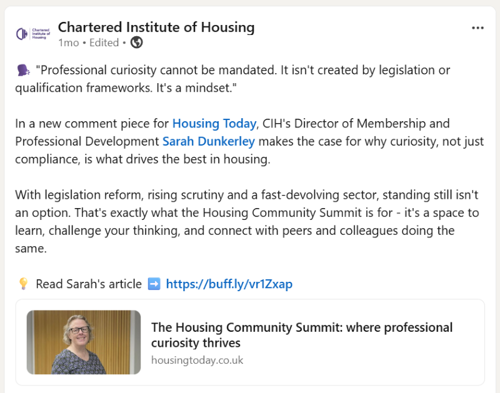
Use LinkedIn to share impactful media stories or comment pieces from CIH spokespeople:
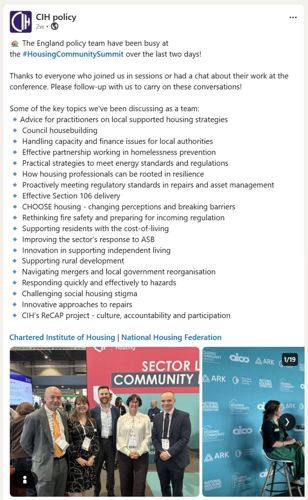
Share key takeaways from CIH events and/or how you were involved:
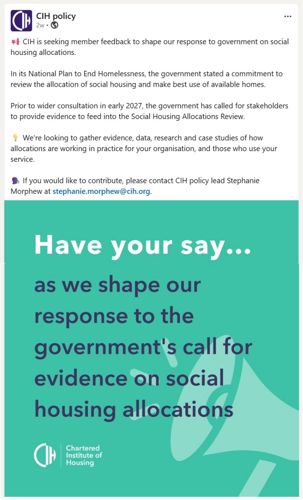
Use your platform to amplify CIH’s voice when we reach out to the sector for feedback or responses to surveys:
For more detailed information, please read our Internet, Use of Email and Social Media policy. This can be found in your Volunteer Pack.
Volunteer-led social media channels
Some of our volunteer groups manage LinkedIn channels for their specific area of CIH work.
These channels can be used to:
- Publish latest news relating to volunteer group activities
- Conduct online polls
- Publicise volunteer group events
- Network with other members
- Share good practice.
We encourage all volunteers to follow these channels and interact where they can with the content that the other volunteer groups are creating.
General guidance on social media use
If you’re managing a volunteer-led social media channel, here’s some general good practice to help keep pages active, consistent and unbiased. Where relevant, full CIH brand guidelines can be found in your Volunteer Pack.
- Make sure at least two or three volunteers, as well as your designated CIH officer, have admin access to the page, rather than relying on one person.
- Take time to fill in the page properly – include a clear description of what the group does, a link back to the CIH website, CIH branded logo and cover image.
- Agree who in your group is responsible for posting and when.
- A page that goes quiet for a few months can look unprofessional and do more harm than posting less often but reliably. It’s better to commit to a sustainable posting pattern – even once a week – than to post in bursts and then disappear.
- It can be useful to create a schedule and plan content a little ahead of time (e.g. for upcoming events or awareness days), rather than only posting reactively.
- Try to mix up content, e.g. event promotion, volunteer spotlights or reshare CIH content with a regional angle.
- Don't post on controversial political news. If something needs a comment from CIH, it will come from national CIH channels.
- Try to include a graphic or image with your posts where possible. This will encourage engagement.
- The first two lines of your post are all that will be visible when users are scrolling through LinkedIn, so make them count!
- Check comments and inboxes regularly. Occasionally, pages can attract spam or hostile/inappropriate replies. If something goes wrong – an inappropriate comment or a post attracting unwanted attention – flag to the CIH comms team as soon as possible.
- Try to monitor what type of posts generate the most engagement and take note of what content resonates best with your audience. This can help with planning future posts.
If you use AI to create social media content, use it wisely with detailed prompts to ensure it sounds authentically like you. Always start with your own thoughts and key facts. Consider these questions when giving your prompts:
- What is the context of the post?
- Who is your target audience?
- What is your platform? (e.g. LinkedIn)
- What do you want to achieve with your post?
To keep your copy from reading like AI, remember to:
- Look out for an overuse of dashes, bullet points, capital letters and adjectives
- Always fact check – AI isn’t always right!
Finally, if you need a graphic or image to accompany a post, contact your designated CIH officer. They can liaise with the CIH marketing team to ensure it is created in line with our brand guidelines. Do not use AI-generated images, or any photography or imagery you do not have permission or licensing rights to use. If you create your own imagery, send it to your designated CIH officer for authorisation before use.
If you would like a session on more in-depth tips when it comes to running your LinkedIn, reach out to the CIH comms team.
Equality, diversity and inclusion
Language is one of the most powerful tools we have. Whether writing an article for the website, engaging with other members, or sharing a case study, the words CIH and our volunteers choose to use reflect who we are as an organisation.
The CIH Style Guide has been updated to reflect our commitment to weaving considerations for equality, diversity and inclusion into everything we do. This can be found in your Volunteer Pack.
The new EDI section is not about following rigid rules. It is a practical resource that supports clear, respectful and effective communication, helping everyone you engage with as a CIH volunteer to feel seen, heard and valued.