


Our volunteer groups and the activities they undertake are an essential part of CIH, so financing these activities responsibly is important for strengthening the wider CIH offer.
This guidance aims to ensure that CIH spends its money wisely, effectively manages costs and guarantees excellent value for money. This is critical for ensuring that CIH makes best use of its resources for the benefit of its members and the wider profession, and that there is a consistent practice across the whole of the organisation.
This section is intended to:
- Give volunteers clear, consistent guidance on how budgets are agreed and managed
- Provide transparency and fairness around volunteer expenses
- Support forward planning by requiring all anticipated costs to be considered in advance of a new financial year
- Remove barriers to participation where possible, while balancing the financial constraints of a membership body.
Where does our funding come from?
Our income comes mainly from membership fees, supplemented by exhibition and sponsorship sales from live events. Our status and funding model means we don’t have limitless funds, so difficult decisions have to be made about which costs can be covered.
Group budgets and expenses
- Volunteer group budgets: A group budget will be necessary if your volunteer group carries out activities for CIH, such as in-person events
- Volunteer expenses: Expenses are budgeted for separately and will be necessary if your volunteer group members travel while volunteering for CIH, such as for in-person meetings.
CIH trustees do not receive remuneration, but reasonable expenses are reimbursed.
The volunteer group you belong to may not require a budget for activities. If this is the case, please skip to the section on Volunteer expenses.
Volunteer group budgets
Our volunteer members know better than anyone what CIH members need from their professional body. We want to ensure that volunteer groups have the power to engage in the activities that they believe are right for the groups of members that they represent. Some of these activities will require funding.
This section is designed to bring transparency to the process for planning and funding volunteer group activities.
How are volunteer group budgets agreed?
The budgets for our volunteer groups are based on a financial forecast for the activities you expect your group to be doing over the coming financial year and are generally based on the previous year’s activities and spend. This is about understanding the individual needs of a volunteer group and will mean forward planning for group costs, including whether you have any new or large projects you’d like to apply for funding to support.
The financial forecast for your group’s activities should be planned with your designated CIH officer. For more detail on processes for planning group activities, please see the section on Volunteer activities. Your group’s forecast will need to be submitted with a budget form via your designated CIH officer. If this is relevant to your volunteer group, this can be found in your Volunteer Pack. You should use the timeline below to guide this process.
Proposed budgets will be reviewed by the designated CIH officer and relevant budget holder, taking account of strategic priorities, previous activity levels, available resources and value for money.
Budget approval timings
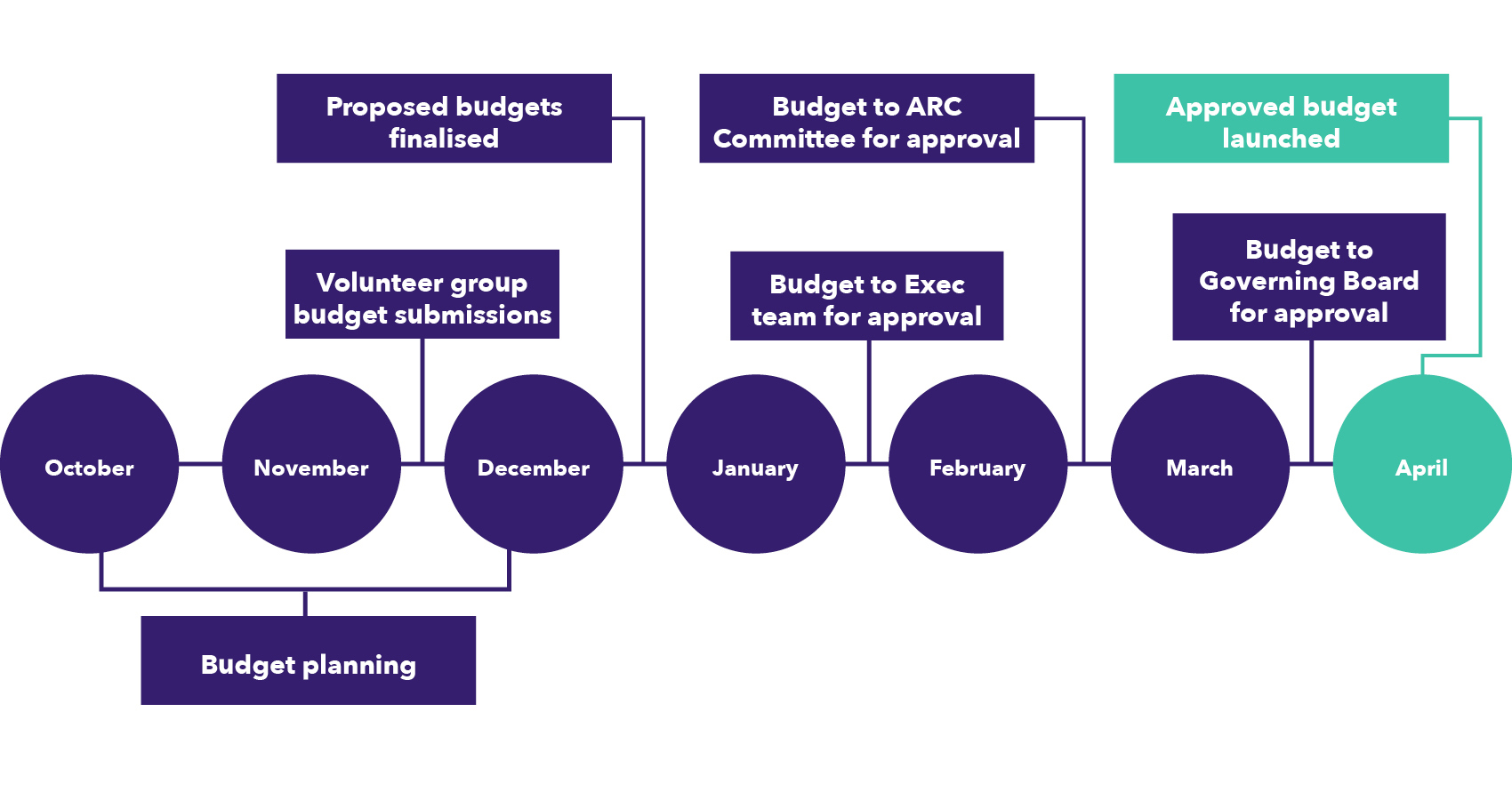
Once approved, your designated CIH officer will be responsible for monitoring expenditure against the budget, working in partnership with the volunteer group to ensure planned activities remain within the approved budget.
What is included in a volunteer group budget?
Core resources, such as banners and other branded collateral are funded separately and do not need to be included in a volunteer group’s budget.
All other costs associated with group activities, such as venue, catering or promotional costs should be included within a volunteer group’s financial forecast.
Any expenditure not included within an approved budget, or any significant variance from the agreed budget, must be approved in advance through your designated CIH officer.
For more detail on planning and budgeting for CIH activities, head to the Member Engagement Toolkit in your Volunteer Pack.
Volunteer expenses
Our volunteer members are active in their support of CIH activities, and some will incur costs in carrying out their volunteer roles. This section is designed to improve understanding of reasonable expenses and bring consistency to the process for reimbursement.
CIH is committed to ensuring that financial considerations do not create unnecessary barriers to volunteering. Volunteers who require reasonable adjustments or support to participate should discuss this with their designated CIH officer.
Which expenses can be reimbursed?
Travel expenses should be reasonable and only claimed where you cannot get your costs funded elsewhere. In this case, travel costs incurred by a CIH volunteer will be reimbursed, providing that the travel was undertaken within the scope of your CIH volunteer role.
Overnight accommodation will only be reimbursed where it has been agreed in advance by CIH and where travel on the same day would be impractical, unreasonable or significantly more costly.
In exceptional circumstances, modest expenditure may be approved for volunteer recognition activities.
Volunteers must not authorise expenditure from which they, a family member or their employer may directly benefit. Any actual or perceived conflict of interest should be declared in accordance with CIH's Conflict of Interest Policy. A Conflict of Interest form can be found in your Volunteer Pack.
You should seek agreement through your designated CIH officer before incurring any expense above £50 on behalf of CIH.
Guidelines for travel expenditure
All CIH representatives are requested to seek best value when booking travel. Public transport should be the default option, and volunteers are requested to book in advance where possible to ensure best value. For all journeys, volunteers are expected to travel standard class unless a first-class ticket is a cheaper alternative.
| Means of travel | CIH expenses guidance |
| Rail travel |
The best value for money is often achieved by booking a specified train. Volunteers are encouraged to do this. If a volunteer uses an Oyster card for rail travel, then the individual amount of each journey should be claimed, and top-ups are the responsibility of the individual. Oyster card journey statements should be attached to the claim as proof of travel, with accompanying receipts wherever possible. These can be accessed either at machines in the station or online. |
| Air travel |
Where it is the most cost-effective method of travel, or business requirements dictate, volunteers can travel by air. All international air travel requires prior approval from the chief executive or director of finance, commercial and corporate services. |
| Privately owned cars |
Where there is no suitable public transport available, or where the use of public transport is impractical, then volunteers may choose to use their own car. Drivers should ensure that their own vehicle is insured for business use, as the driver is personally liable for any incident. The policy must be a minimum of third party, accident, fire and/or theft insurance cover and include cover for bodily injury or death of third parties and passengers, and damage to property. CIH does not provide car insurance for private vehicles being used for business purposes. Car parking, congestion and toll charges which are incurred when travelling on business and supported by receipts will be reimbursed. CIH will not, under any circumstances, reimburse parking fines, road traffic fines, congestion charge fines or penalties. |
| Taxis |
Taxis should not be used where there is appropriate alternative public transport (bus, tube, train). Taxis may also be used if heavy articles are being carried, a volunteer is pregnant, has a disability or injury, or where personal or financial security is an issue. Travel by taxi should be kept to a minimum and must not be used for long journeys. |
Governing Board exception
Governing Board members/trustees undertake their roles voluntarily, as do all other CIH volunteers. However, the role of Governing Board member/trustee carries much greater responsibility, including in the eyes of the law should CIH face legal proceedings.
In recognition of the challenging nature of their role, the event budget will pay for travel and accommodation for the Housing Community Summit, and the same will apply for the Presidential Address and Charitable Appeal, along with a ticket for this event.
Providing travel and accommodation for other events will be assessed on a case-by-case basis i.e. if they are part of the programme as a speaker.
How to claim travel expenses
Expense claims should be submitted within two weeks of the expense being incurred to support good financial management.
To submit a claim, you will need to complete the CIH volunteer travel expense form. This can be found in your Volunteer Pack. Full details of all journeys including the date, reason for the journey, starting point and destination should be shown on the expense claim form. For reimbursement of travel expenses by taxi, it should clearly state on the expense claim form the reason for use of a taxi rather than public transport.
This form should be given to your designated CIH officer, who can then approve the expense before sending it to our finance team for processing.
It is essential to submit original VAT receipts with the claim form to enable CIH to recover VAT from HMRC. Each expense must have a receipt. A credit card counterfoil is not valid as a receipt. The receipt must clearly identify what has been purchased and how much has been paid. If correct receipts are not submitted, the expense may not be reimbursed.
Claims should be submitted promptly and no later than 30 April for expenditure incurred before 31 March. Claims received after this date may not be reimbursed unless exceptional circumstances apply.
When will I receive my reimbursement?
Reimbursement normally takes place within 14 days of submission.
All payments will be made by BACS directly into the claimant’s bank account, details of which need to be advised to finance.